
Warm Ice: A Landscape Photographer's Journey Through the Ross Sea
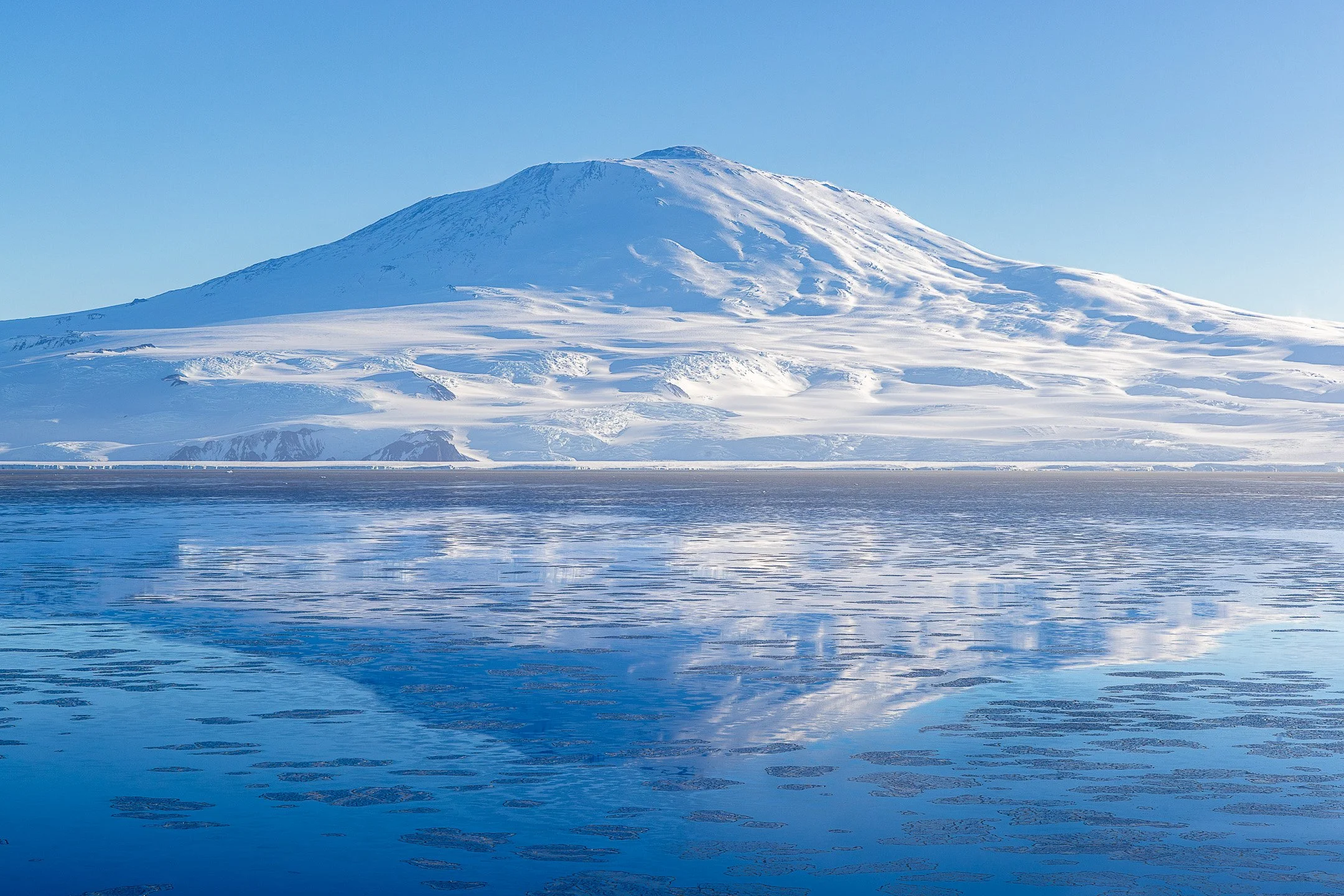
Silent Erebus - Ross Island, Antarctica
The first thing I noticed was the land. It was early morning, somewhere south of the Balleny Islands, when I stepped out onto the deck into the biting air. The ship was slicing through water the colour of deep ink, and ahead, the Adare Peninsula was just beginning to take shape. This was the northern edge of the Ross Sea, a region I had only ever known from flat maps and distant names.
Massive, sculpted icebergs already littered the horizon, scattered across the dark water like deliberate sentinels stationed between the ocean and the continent, completely unhurried by our approach.
Ever since leaving New Zealand, I had been forced to adjust the way I looked at things. The Subantarctic islands used wildlife to give the landscape scale, while the Ballenies introduced a brutal kind of weather and an intense glare that was genuinely difficult to process. By the time our journey brought us into the Ross Sea, I assumed I had finally clocked the rhythm of the place, but I was completely wrong.
The ice down here was on an entirely different scale, making it near impossible to tell where the frozen sea ended and the actual coast began. Because the sun stayed so low, crawling laterally across the sky, it brought out a palette of golds, pinks, lavenders, and bronzes. These were warm, rich colours that I simply never associated with the far south and certainly never expected to find. I went down there anticipating nothing but the cold, but visually, the continent offered a completely different story.
The photographs from the journey fall into distinct chapters. Each group acts as a small fragment of that expedition, tracking the way the Ross Sea gradually revealed itself, upending my expectations and showing what the place looks like in reality.
Living Ice Landscapes
At first, the icebergs were nothing more than vague shapes low on the horizon, easily mistaken for distant banks of cloud or a smudge of coastline. As the ship pressed closer, they began to separate and define themselves. By the time the Adare Peninsula loomed behind them, the ice was fully present, claiming the entire expanse between the open ocean and the land.
When you get up close, the colour catches you well before anything else. It is not white at all, but a dense, saturated blue that seems entirely internal. The shade does not simply sit on the surface; it feels deeply embedded, giving the impression that the ice is generating its own light from within.
Yet it takes a moment of movement across that frozen mass for the true scale to register.
A line of Adélie penguins travelling across the face of an iceberg provides that missing context. From a distance, they appear as tiny, static marks, then as a subtle ripple of movement, and only after a few seconds do they finally resolve into actual animals. Without those creatures, the ice remains incredibly difficult to measure, becoming an abstraction of pure form and texture without any human reference point. The penguins are never the main subject of the view, but their presence is what makes the true proportions of the landscape visible.
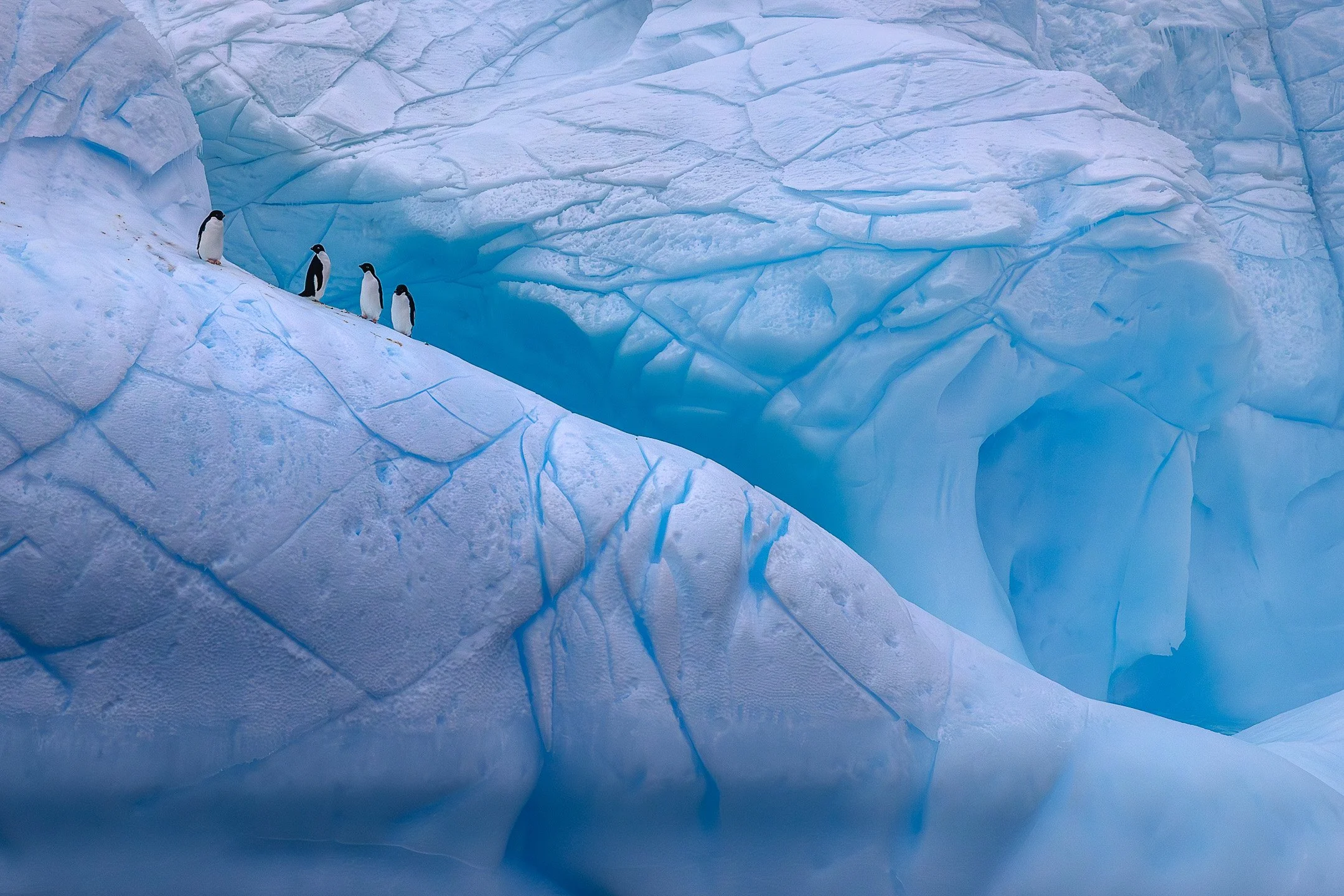
Black and White on Blue - Cape Adare
Four penguins pause on the fractured surface of an iceberg, their monochrome forms sharp against a field of deep glacial blue. The crevasses behind them suggest depth and age — a history written in ice.
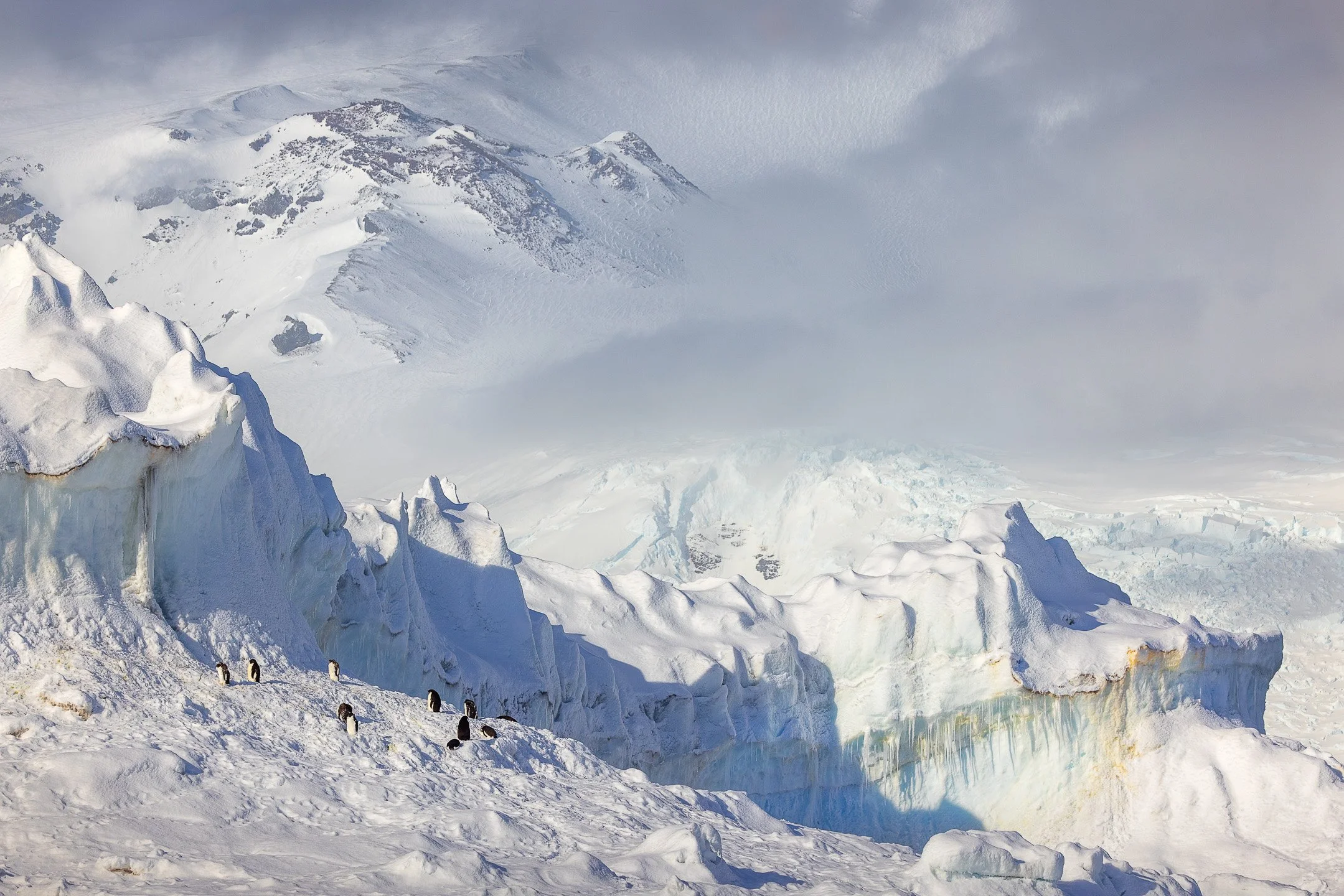
Cliffs of Ice — Robertson Bay
A vast wall of glacial ice rises along the Robertson Bay coastline, its face streaked with the compressed layers of centuries. A small group of Adélie penguins move along the base, dwarfed by the scale of what lies beyond them.
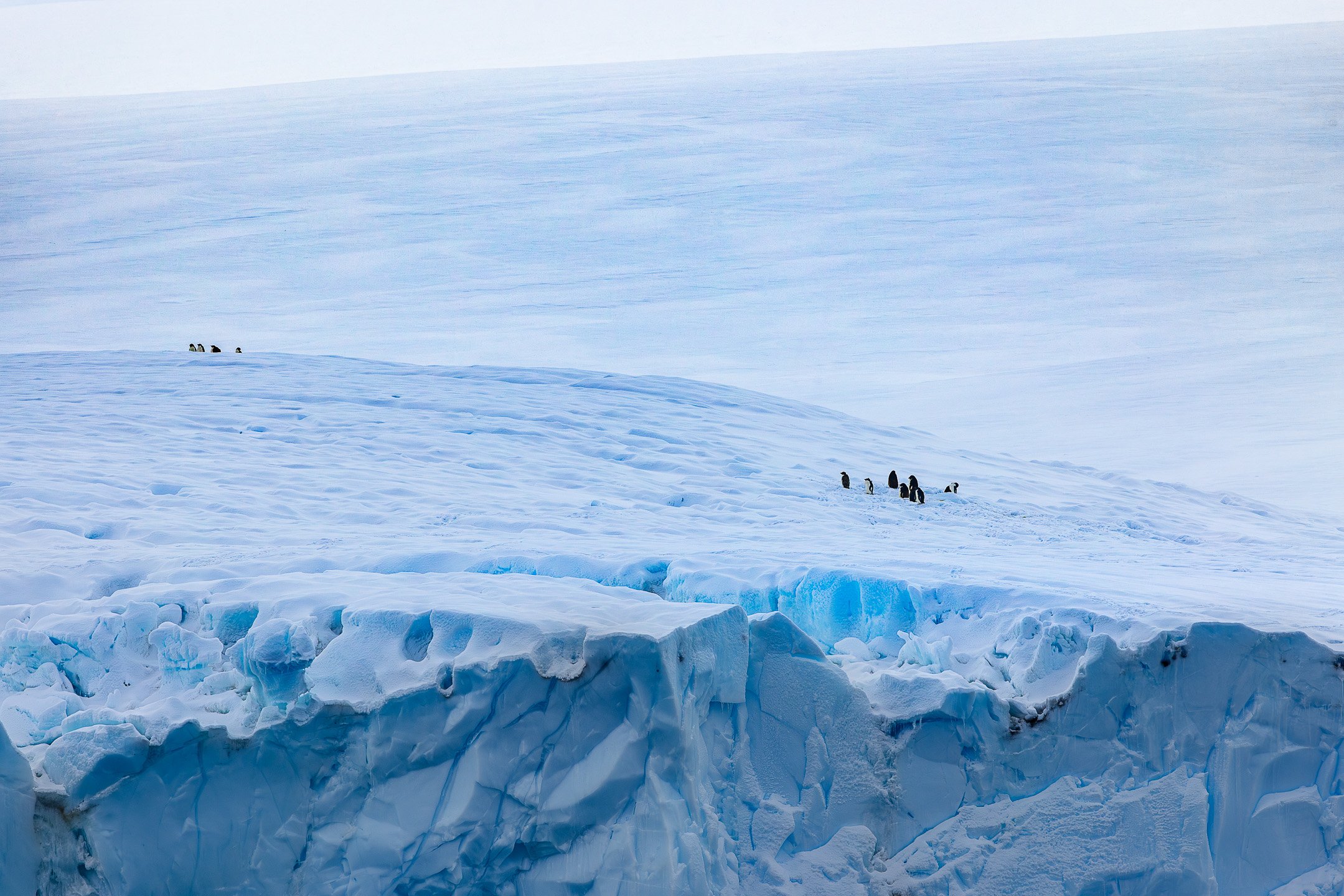
Shades of Blue - Robertson Bay
From the sculpted blue edge of an ice cliff to the pale expanse of the ice plateau above, the image is an exercise in tonal restraint — a landscape reduced to a single colour and its infinite variations.
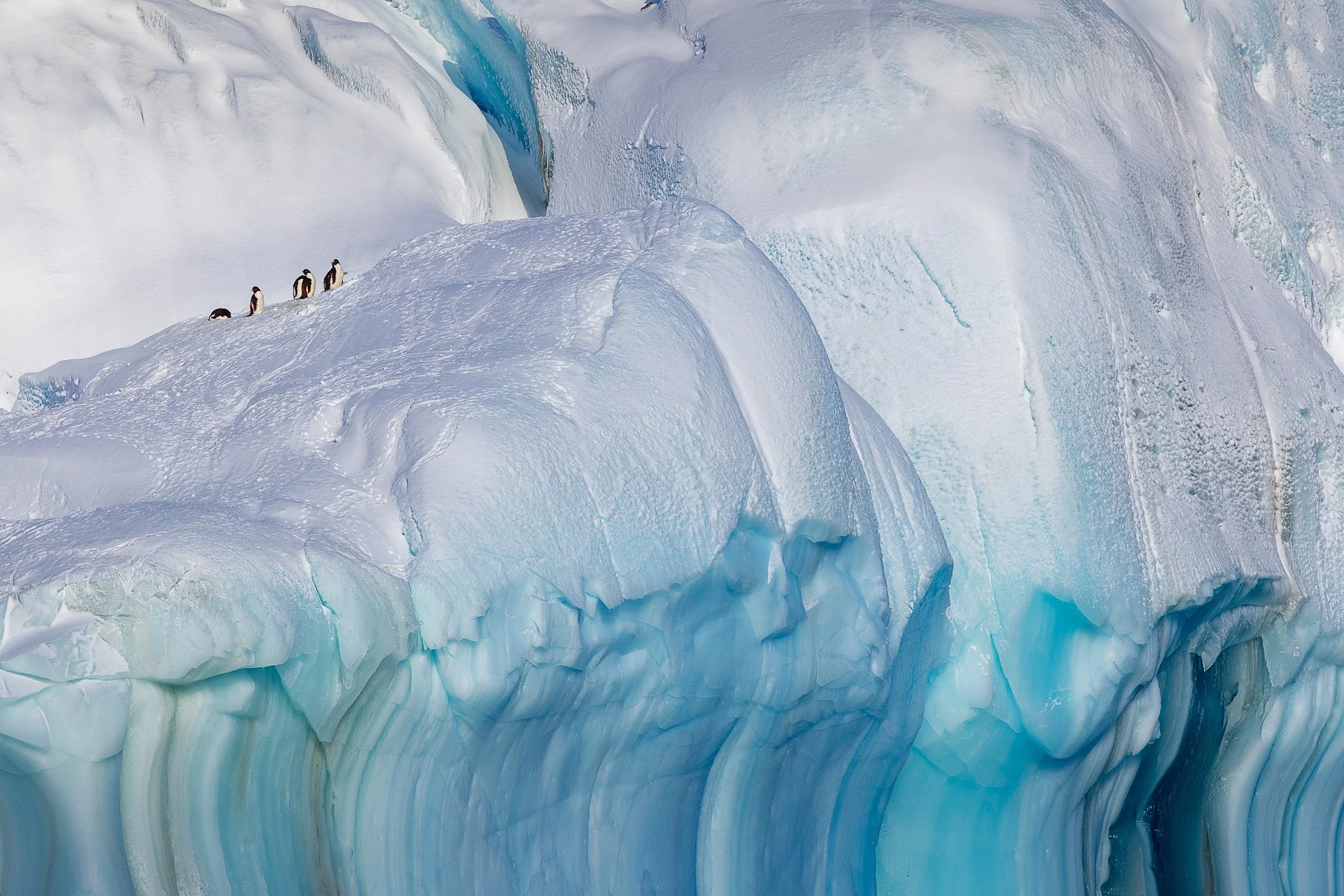
Passengers on Blue Ice - Adare Peninsula
A group of Adélie penguins crests the rounded shoulder of a massive iceberg, their scale so diminished by the surrounding ice that they read first as texture, then as movement, and only finally as life.
Blue Stillness
At times, the water turned completely flat, a motionless surface holding the sky so precisely that the horizon line vanished, making it impossible to tell where the ocean ended and the air began. The entire palette narrowed down to a stark combination of blue and white, reduced to just ice, sky, and the thin ribbon of dark land that interrupted both.
Every bit of sound seemed to recede. Even standing out on the deck of a moving ship, a profound quiet took over, one that felt entirely disproportionate to our actual surroundings. The steady thrum of the engine was still there and the water was still parting around the hull, but neither sound seemed to carry. The massive landscape just swallowed it whole.
I found myself working much more slowly in these conditions. Down in the Subantarctic and around the Balleny Islands, the main challenge had been keeping up with the wild weather, the erratic movement, and the constant arrival of something new. Here, the struggle was completely different, requiring me to just observe and wait.
Often, absolutely nothing happened. The surface stayed unbroken, the light remained frozen in place, and the scene sat complete in its own heavy stillness. Other times, the slightest shift was enough to change everything, whether it was a stray fragment of ice drifting into perfect alignment, a volcanic mountain settling into its own mirror reflection, or a new line forming through the camera frame that had been invisible a moment before. Those were the only moments that truly mattered.
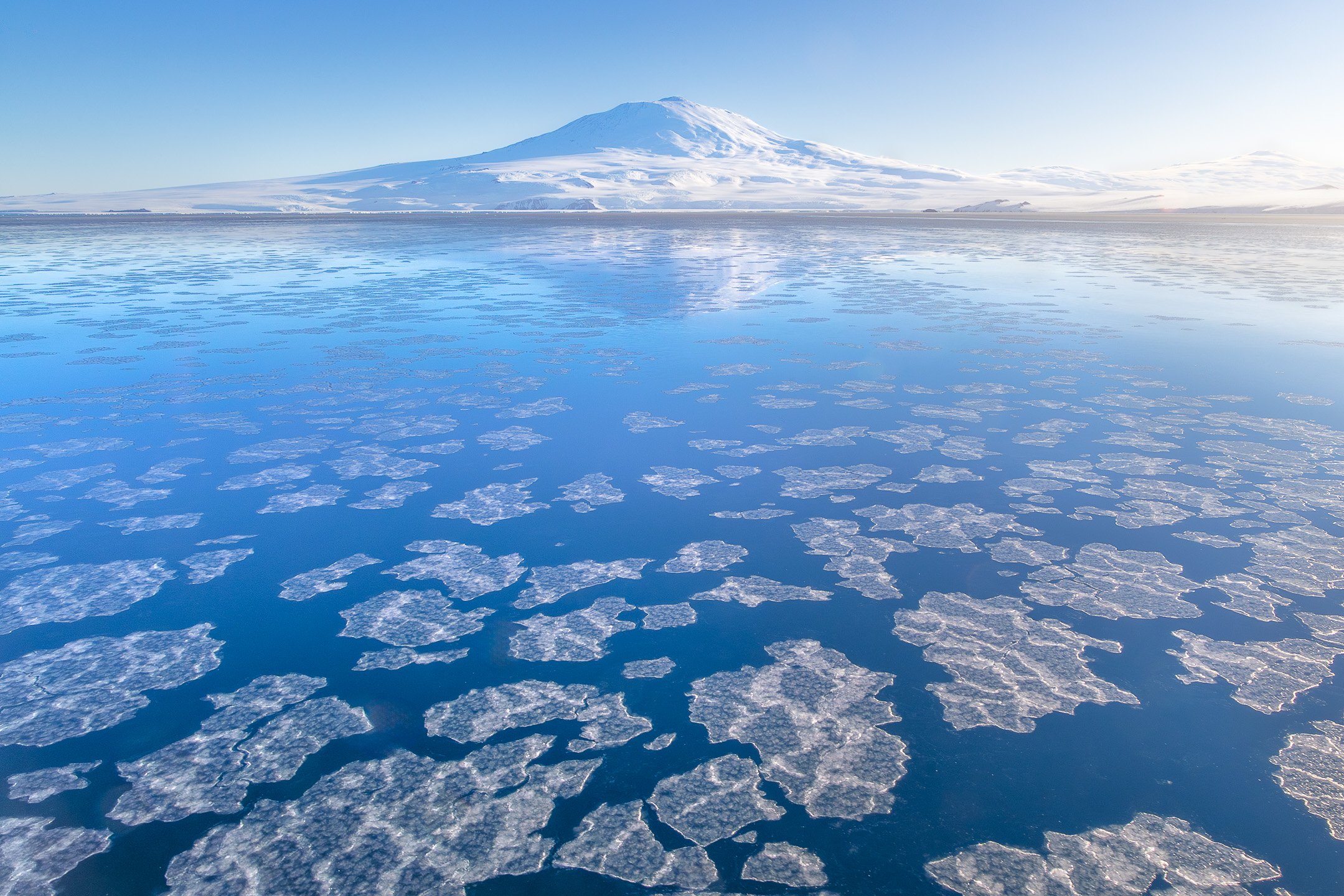
Ice Scatter Before Erebus - Ross Island
Fragments of sea ice drift across a surface so calm it holds the sky perfectly. Mount Erebus, Antarctica's active volcano, rises in the distance, its presence here a quiet reminder that beneath this blue stillness, the continent is anything but inert.
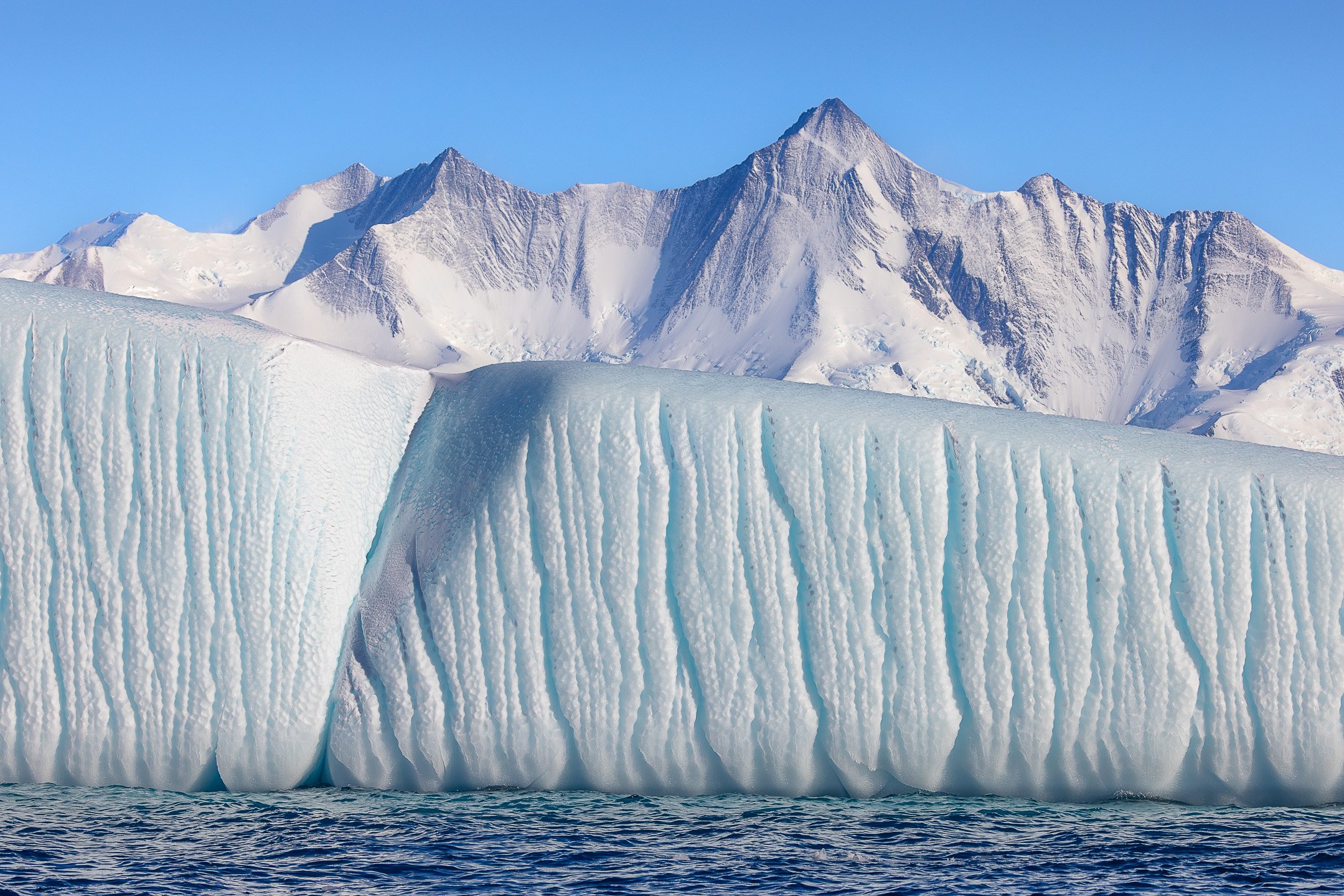
Lines of Descent - Cape Hallett
The vertical grooves of a tabular iceberg, caused by water erosion and melting, mimic the couloirs etched into the mountain peaks behind them.
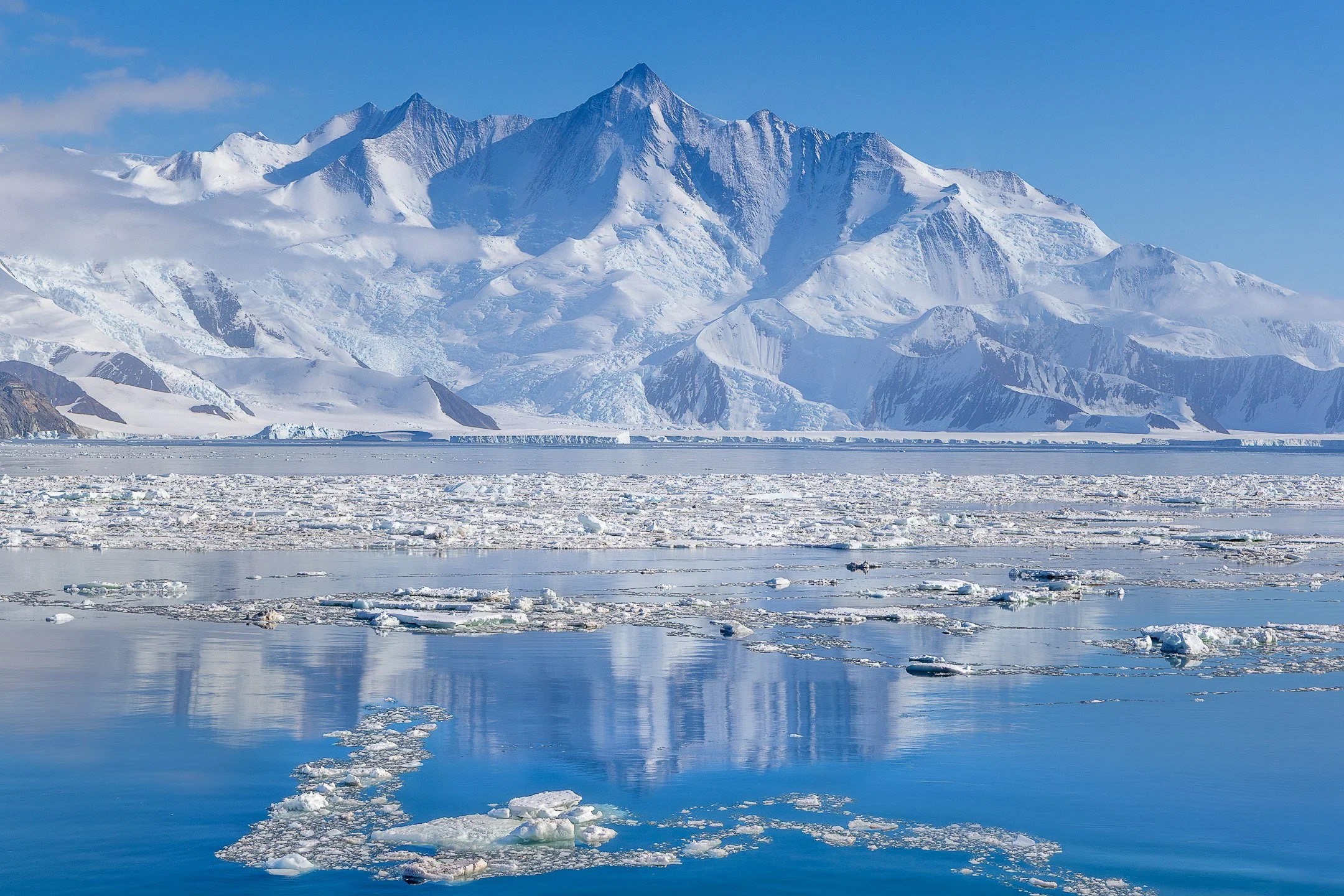
Stillness Beneath Mount Herschel - Cape Hallett
Calm settles over Cape Hallett as Mount Herschel is mirrored in still, ice-laced waters—its presence softened into quiet symmetry.
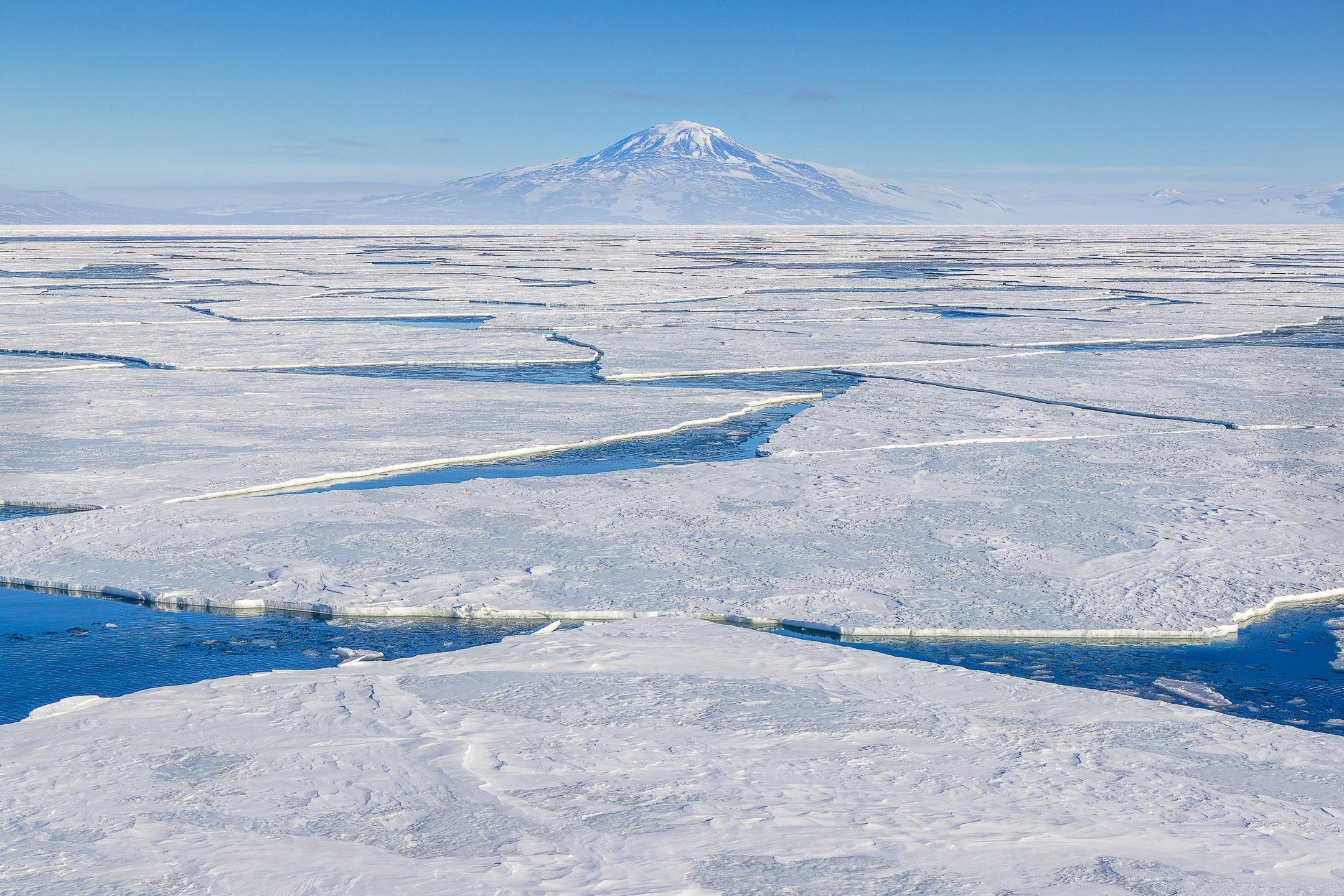
Blue Path to Discovery - McMurdo Sound
A lead — a narrow channel of open water cutting through the sea ice — draws the eye toward the distant cone of Mount Discovery on the horizon.
Pancake Ice
At first glance, it looks nothing like ice. From a distance, the ocean surface breaks apart into thousands of small, rounded shapes that rise and fall gently with the swell. With their soft edges and slight separations, the forms feel closer to something living than something freezing.
For a while, I struggled to find a comparison for what I was seeing. That slow, suspended movement reminded me of jellyfish drifting aimlessly with the current, and it was only as the ship pressed closer that the true structure of the ice began to define itself.
Each individual disc was completely distinct, perfectly circular with a slightly raised rim where it nudged against its neighbours. They pressed together, drifted apart, and bumped again, following no single direction but creating a constant, quiet adjustment across the water. While it appeared as a flat pattern from the deck, looking down closely transformed it into a rich, moving texture that felt far less like the open ocean and much more like the water lilies in a Monet painting.
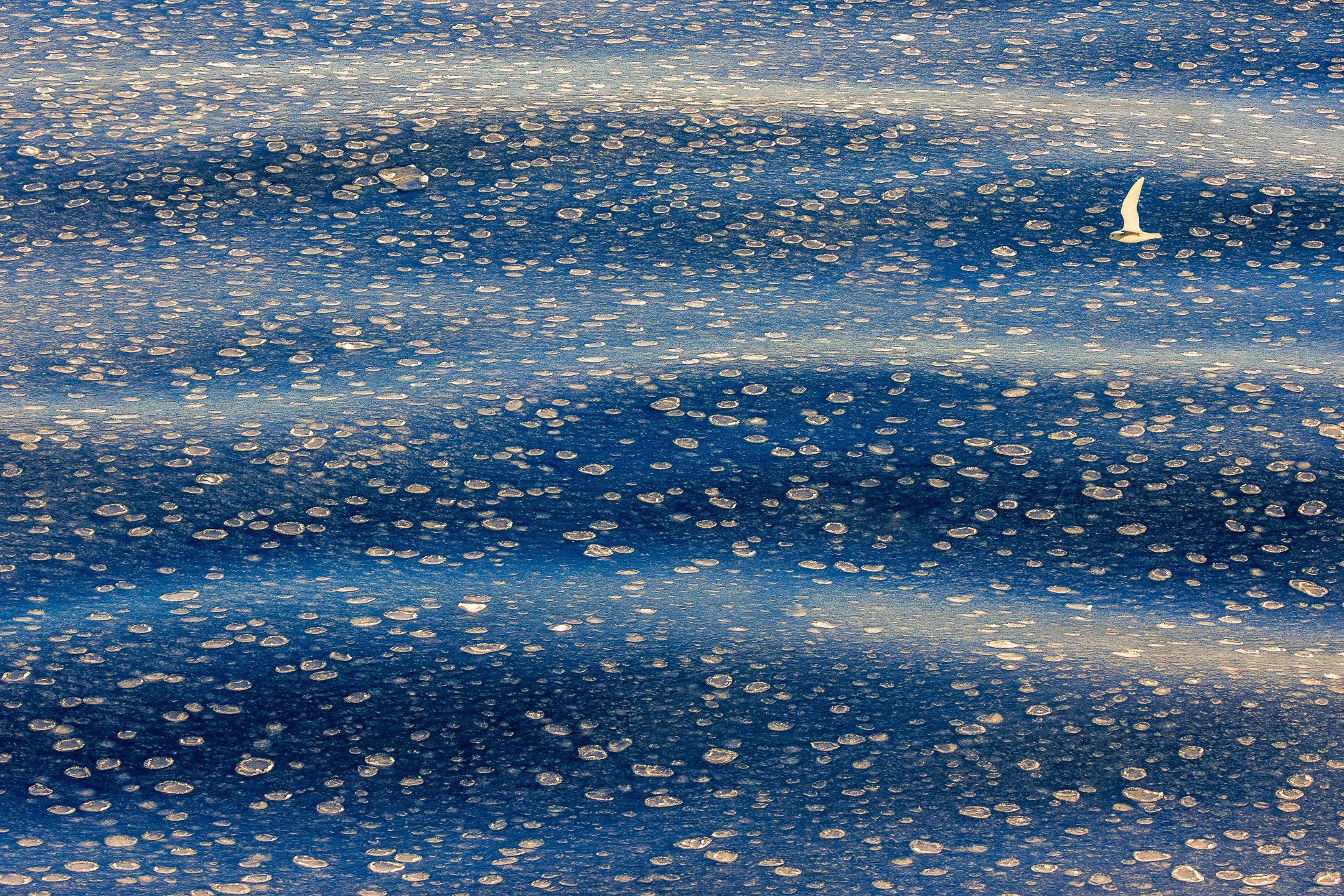
Anomaly - McMurdo Sound
A snow petrel moves through the frame, so small against a field of pancake ice that it takes a moment to find.
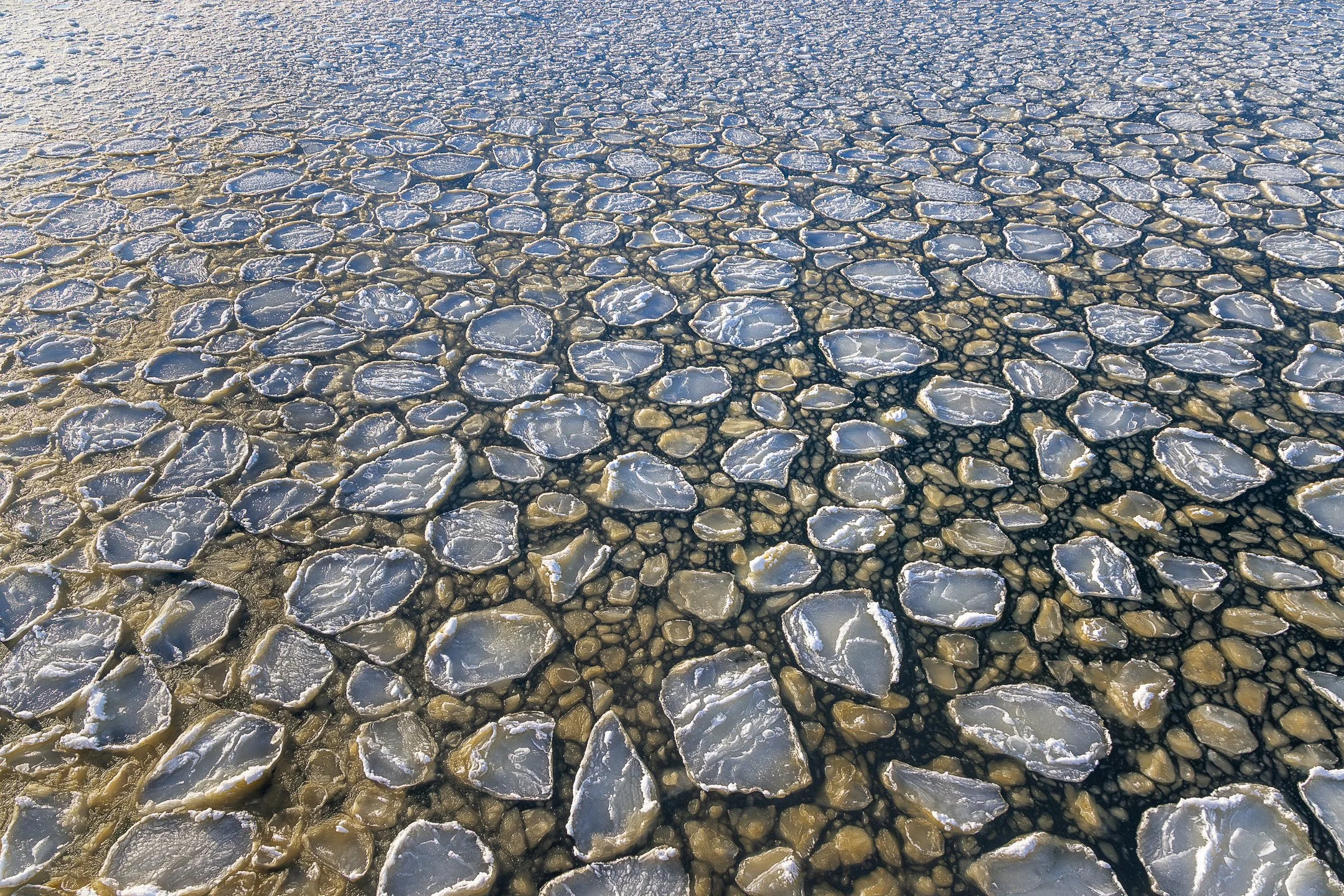
Water Lilies - Terra Nova Bay
Pure pancake ice, densely packed — the circular forms separated by thin lines of water stained gold by diatom algae.
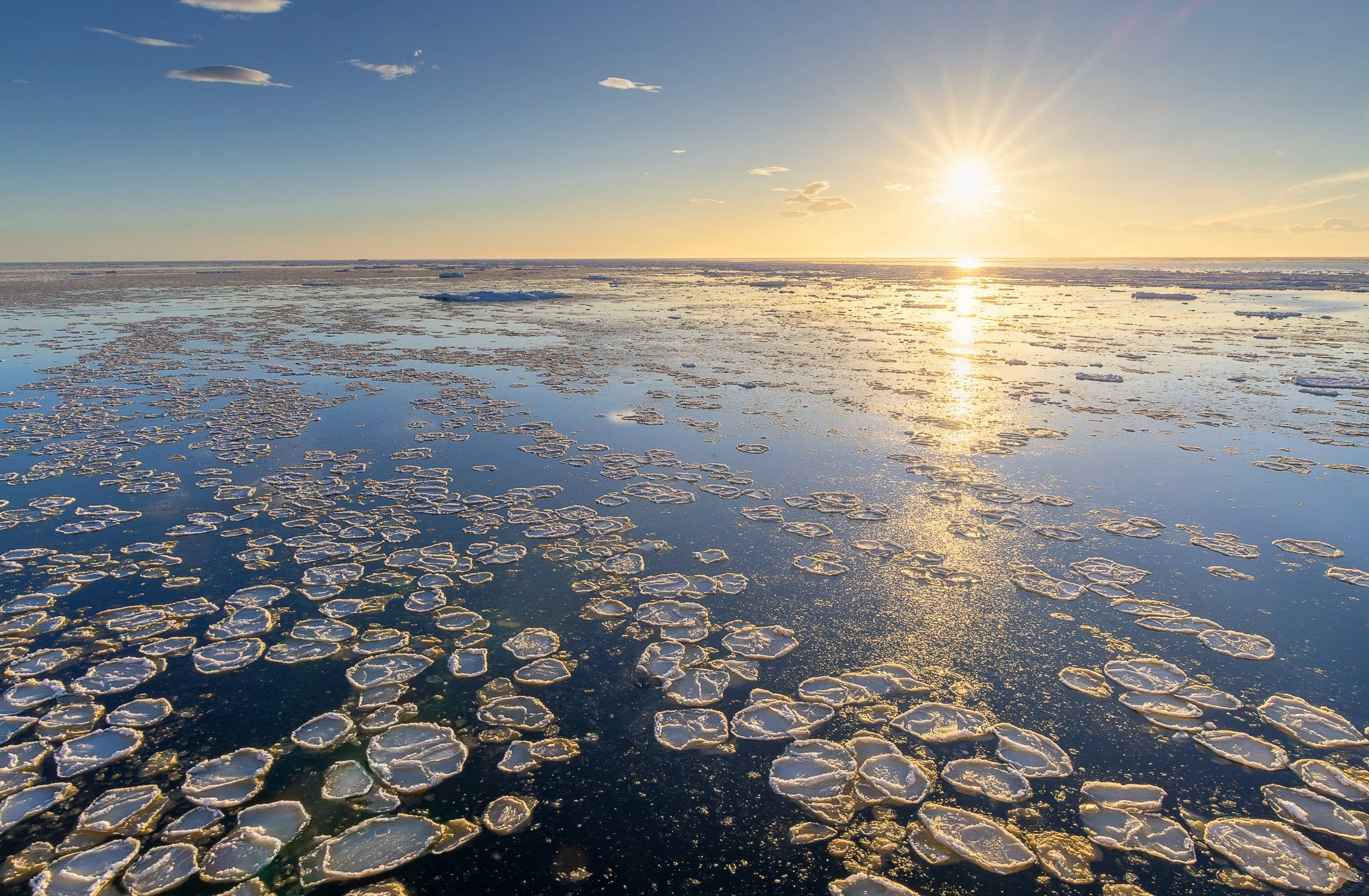
Endless Lilies - Terra Nova Bay
Pancake ice extends toward the horizon, the sun's reflection tracing a path through the discs to the vanishing point. The scale of what you are looking at only becomes clear when you realise the horizon is not close.
Volcanic Gold
The ice draws you in first, but the moment land appears, the contrast hits you. It’s a stark, heavy collision—black volcanic rock cutting through pale ice, hard lines striking against soft, frozen forms. It serves as an immediate reminder that beneath all this frozen stillness, a much older, restless geology is waiting.
I already knew the Ross Sea was volcanic long before I arrived. I was familiar with the maps, the names, Mount Erebus, Ross Island. But studying a place conceptually doesn't prepare you for the actual weight of seeing it.
Cruising through McMurdo Sound, we were completely walled in by those dark volcanic peaks. But as the sun dipped toward the horizon, the landscape began to shift, taking on an unseasonable, almost impossible warmth. The dark rock suddenly turned reflective, absorbing and holding the low light until the islands glowed with rich, deep colour. Even the snowpack above them changed, catching soft tones that felt entirely borrowed from a different latitude.
The wildlife went on about its business, completely indifferent to the drama of the light. Orcas kept slicing through the glowing water, and seabirds continued their steady tracks across the sky.
Then, for just a few moments, everything aligned perfectly. The light hit a precise angle where rock, snow, water, and air all held the same golden hue at the same time. The landscape didn't just look illuminated; it felt entirely transformed. For a brief window, Antarctica felt warm.
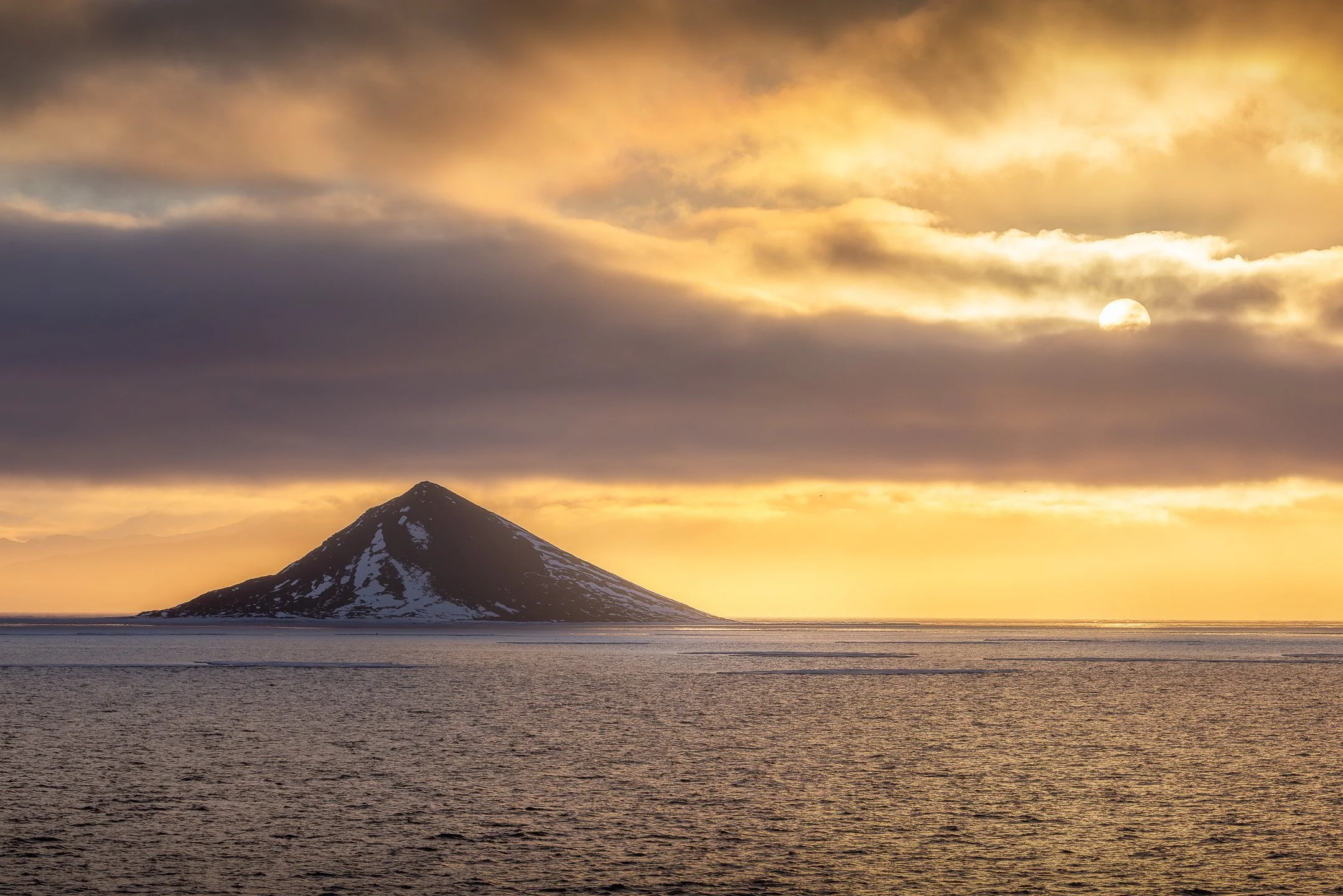
Antarctic Pyramid - McMurdo Sound, Ross Sea
A perfectly conical volcanic peak rises from the sea, centred beneath a dramatic golden cloud system with the sun hidden but radiating behind it. The cone is almost architectural — a form so precise it seems deliberate.
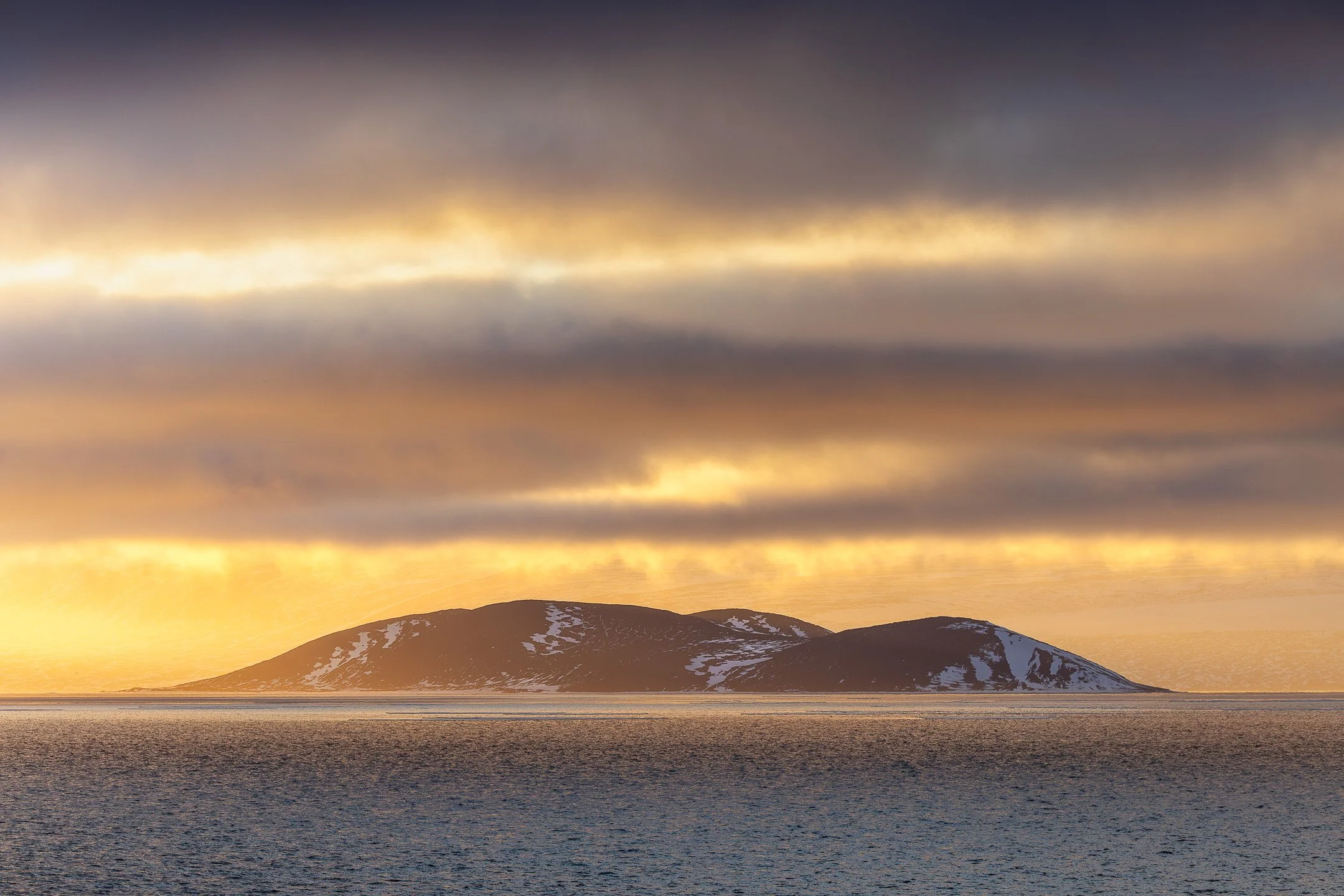
All but Flat - McMurdo Sound, Ross Sea
A low volcanic island sits on the horizon, perfectly balanced between an immense, flat plain of sea ice and a layered golden sky. The entire composition relies on these heavy horizontal bands, stacking ice, water, rock, cloud, and light on top of one another, all held together by the quiet, rounded presence of the island itself. Absolutely everything within the camera frame is completely flat, except for the spectacular light, which is anything but.
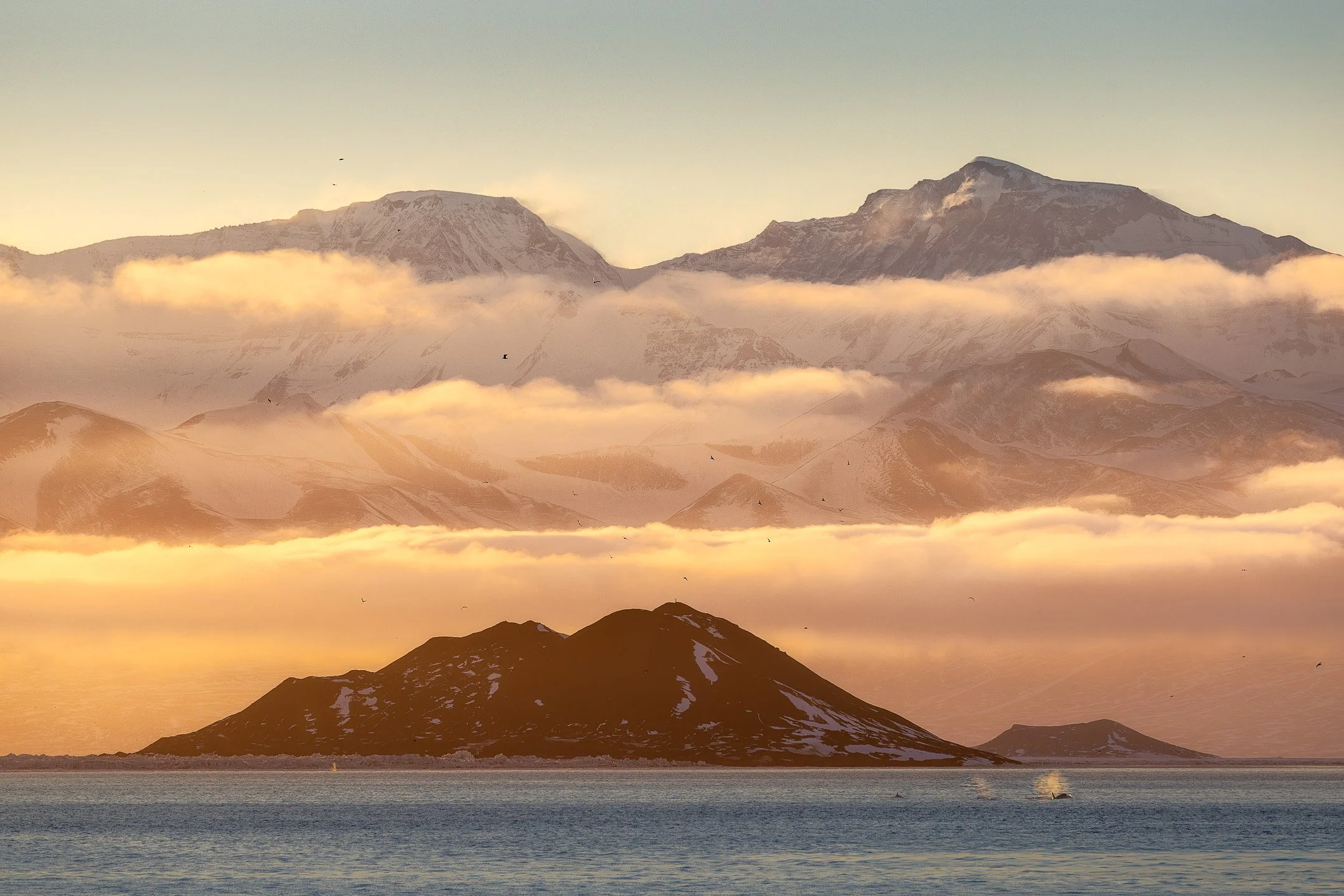
Not Alone - McMurdo Sound, Ross Sea
Two volcanic islands rest in a sea of gold, beneath layers of light and mountain peaks. Look closely: there are orcas in the water and birds in the sky. This landscape is alive.
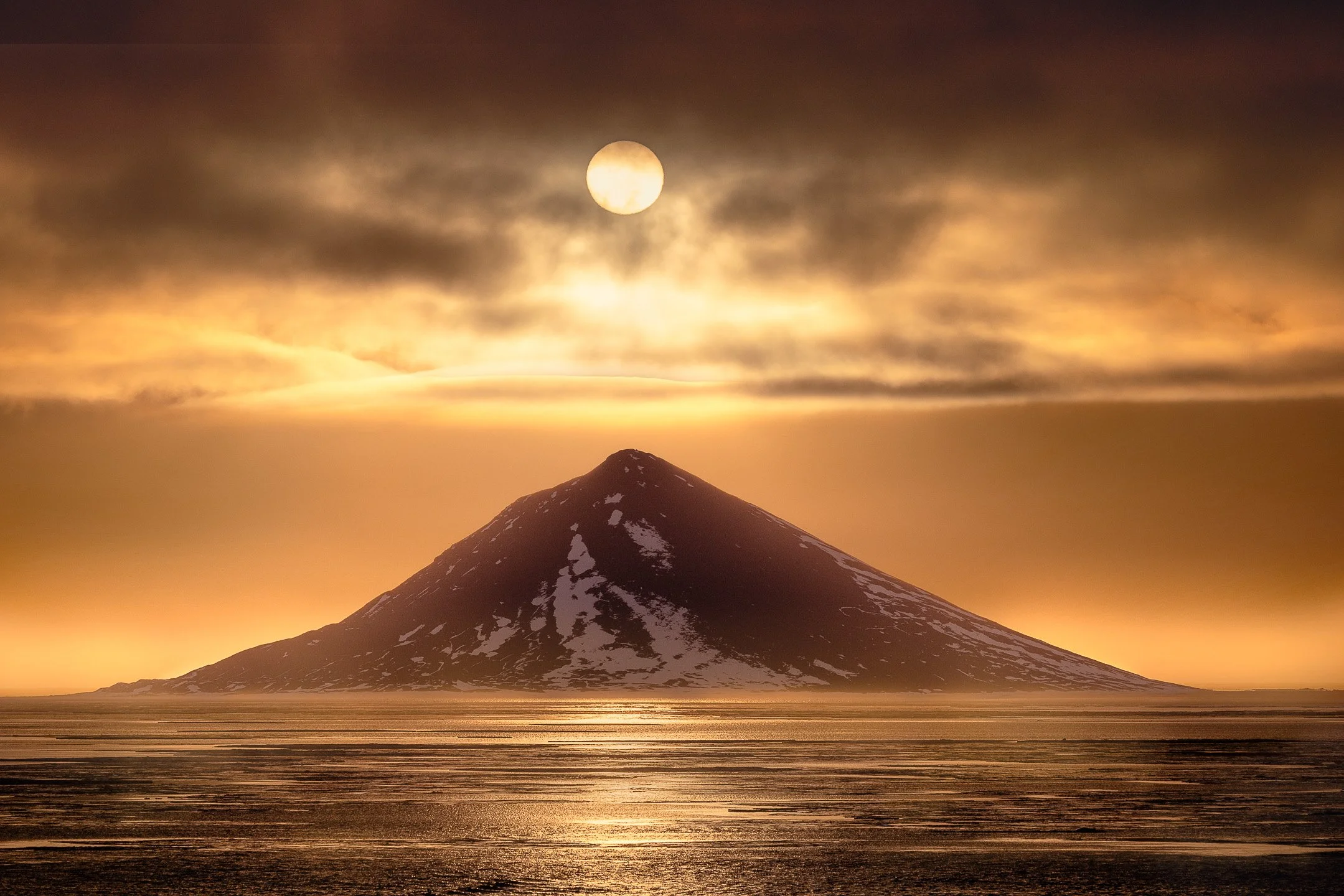
Solar Alignment - McMurdo Sound, Ross Sea
A diffused sun settles above a pyramid-shaped island in McMurdo Sound, its light softened by cloud and reflected across the water.
The Colour of Cold
You don’t go to Antarctica expecting pinks, golds, or lavenders. Leaving New Zealand, the mental map I carried was strictly monochrome: white, blue, and a sterile grey, just ice and sky with nothing much bridging the gap. Slipping into the Ross Sea completely upended that.
Down here, the light operates by an entirely different set of rules. Because the sun moves laterally rather than dipping below the horizon, it hangs low for hours, skimming the landscape at a radical angle that changes everything it touches. Suddenly, the ice strips off its uniform white and begins to bleed colour.
It’s not a sudden revelation. At first, you dismiss the warm hues as a fluke—a passing anomaly. But then it happens again, and again, until it finally sinks in that what you always accepted as "Antarctic colour" was really just a single, limited version of it.
I experienced this across different parts of the Ross Sea — McMurdo Sound, Terra Nova Bay, the Ross Ice Shelf — but the location matters less than the condition. They all come from the same kind of light: low, sustained, and directional enough to reveal colour that remains invisible for most of the day.
None of these moments are built to last, of course. The colour slips away just as quietly as it arrived, the landscape snaps back to its default whites and blues, and your baseline expectations reset.
I went south looking for the cold, and physically, the continent delivered exactly that. But visually, the place offered a total counter-narrative. It wasn't a barren absence of colour, but an overwhelming, fluid presence of it, all anchored to a sun that refuses to behave in ways we are used to. The biting cold never actually leaves; it just stops being the thing that defines the trip.
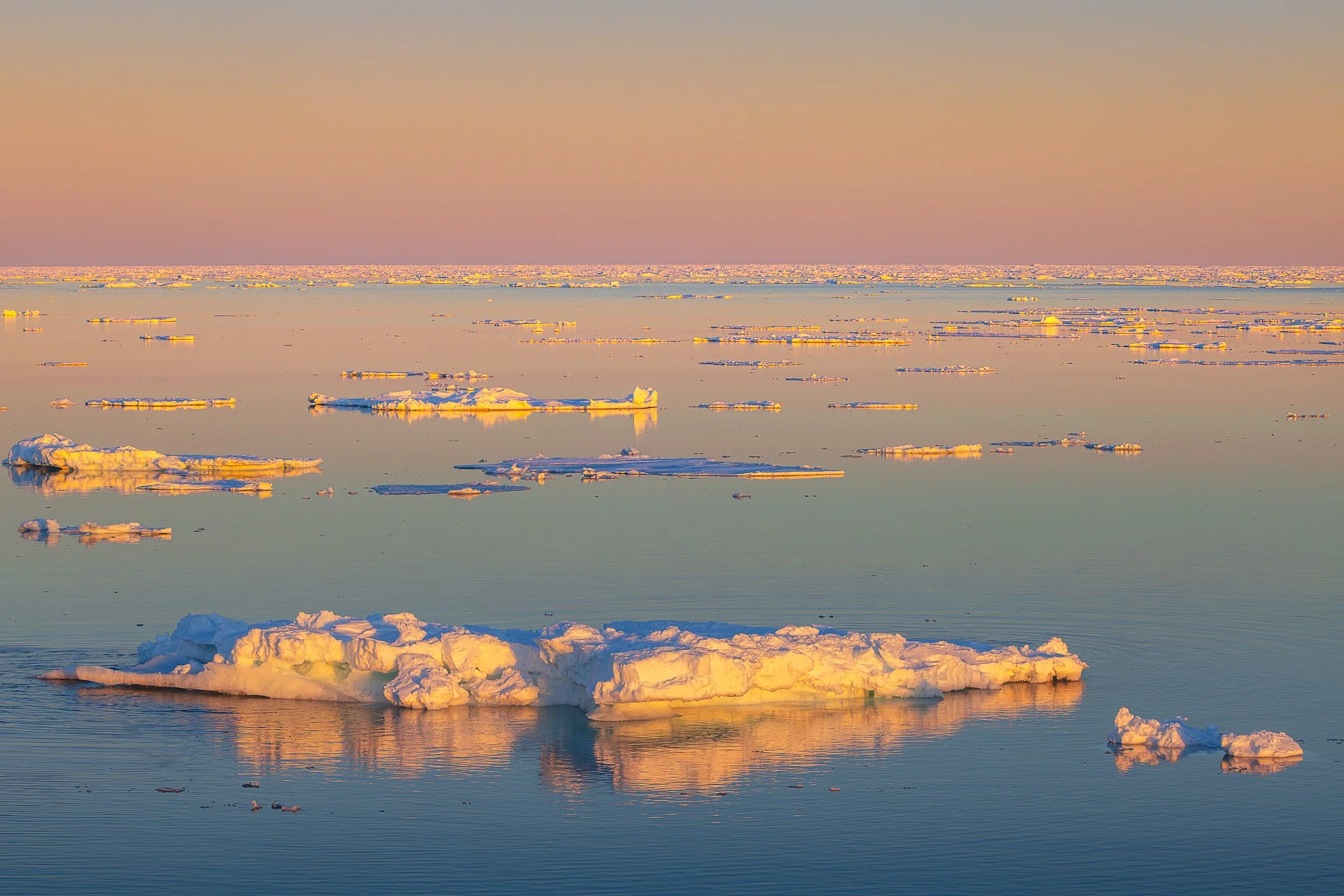
Warm Silence - Terra Nova Bay
No sun. Just the ambient warmth of a long Antarctic evening settling across scattered ice and mirror-flat water.
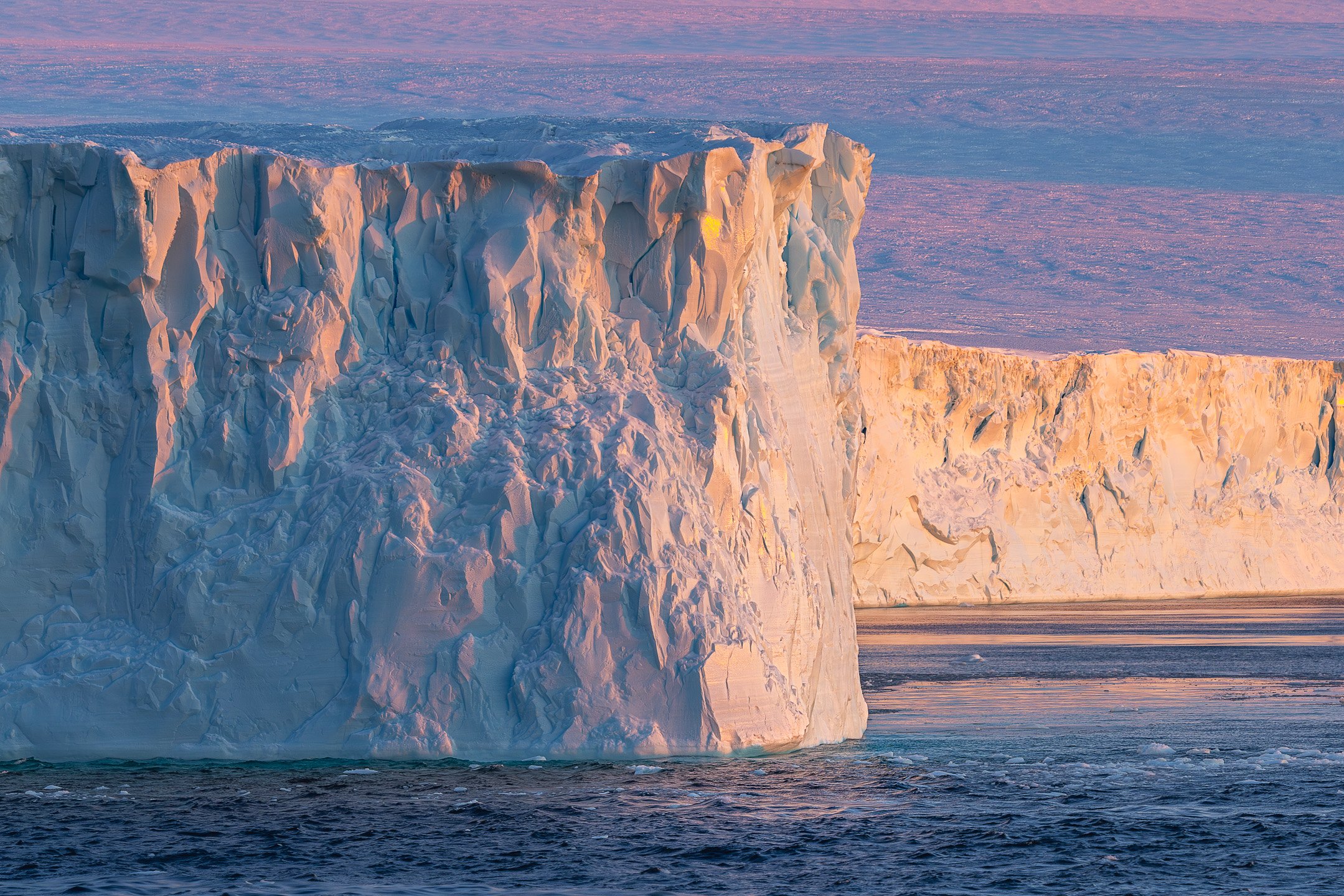
Wall of Gold - Ross Island
The vertical face of an ice shelf catches the last horizontal light of a midnight sun, turning what is ordinarily white into something closer to burnished gold.
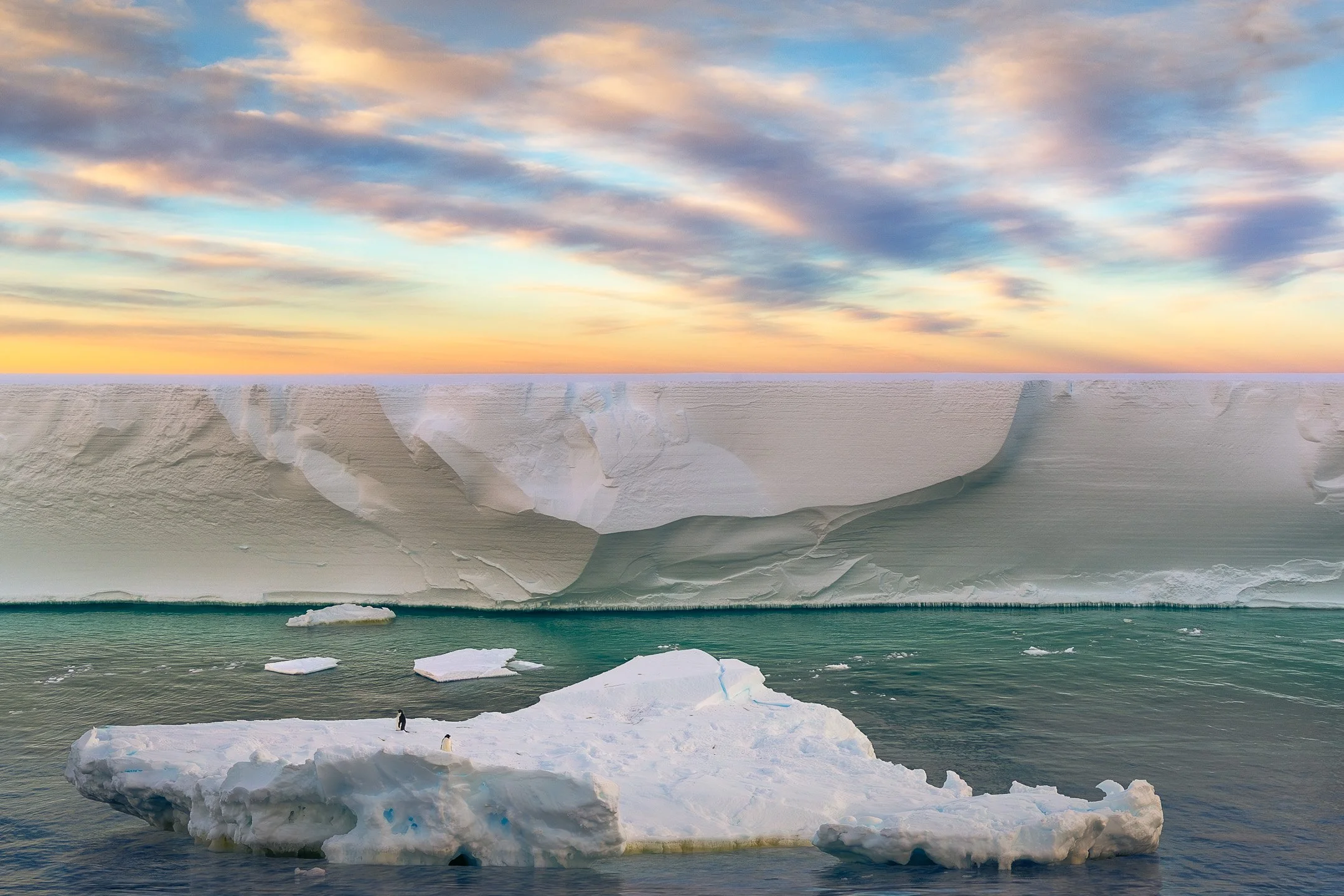
The Parade - Ross Ice Shelf, Ross Sea
Two Adélie penguins drift past the face of the Ross Ice Shelf on a small irregular floe, the teal water between them and the ice, a pastel sky of gold and lavender above. A colourful parade.
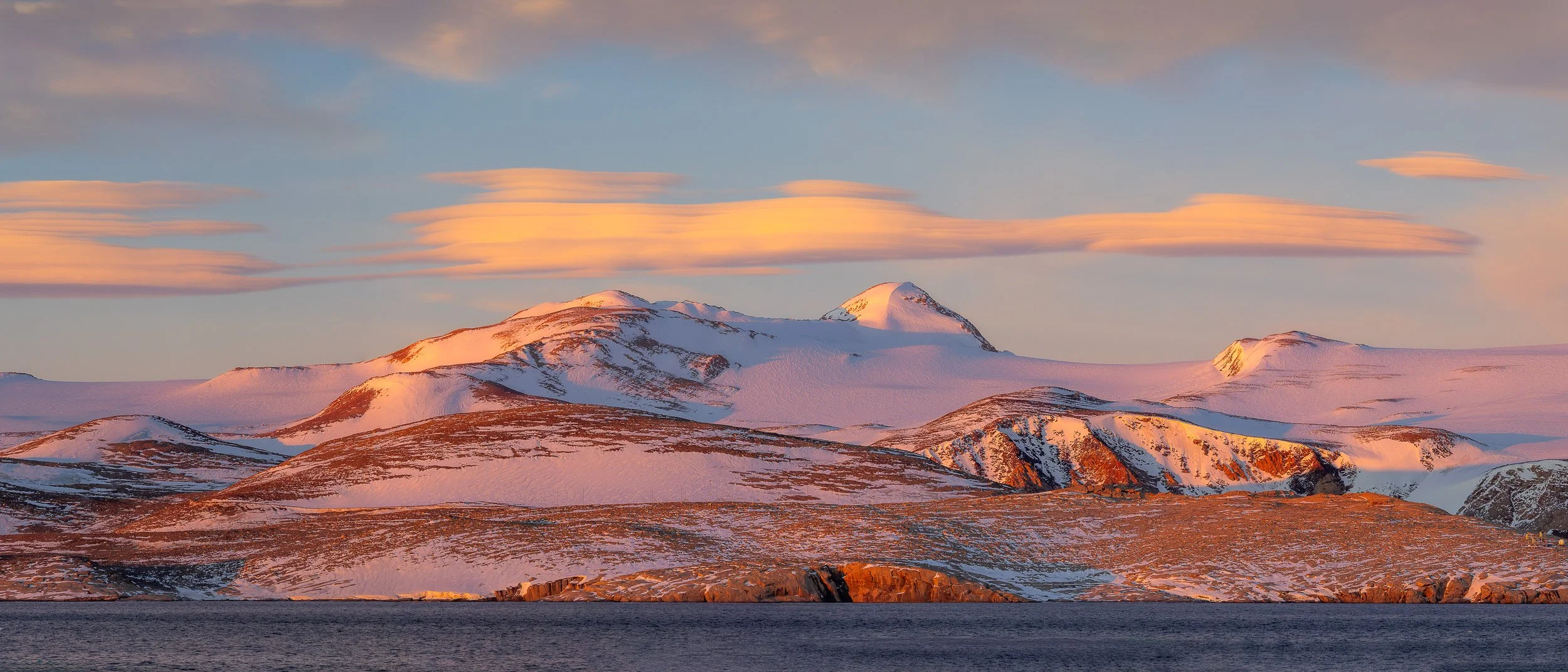
Rust and Snow - Terra Nova Bay
At 5:30 in the morning, the light that never fully left catches the volcanic peaks above Terra Nova Bay at an angle that colours the snow pink and gold. The exposed rock beneath it displays a deep rust colour. Antarctica, at this hour, is not cold in any colour you were expecting.
Photographing Antarctica: Platform, Light, and the Limits of the Single Frame
A Moving Platform
In Antarctica, your shooting platform is almost always given to you, and it never stops moving. The ship serves as your base, your transport, and frequently your primary shooting position, while the smaller Zodiacs take you much closer at the expense of stability. Each vessel demands a completely different approach. From the ship, you work with distance and a heavily compressed perspective, but from a Zodiac, the focus shifts entirely to proximity and raw texture. Because of this constant motion, fast shutter speeds and elevated ISO levels quickly became my standard settings. Technically flawless images stopped being the main goal, as clarity of intent and precise timing were all that truly mattered.
Light That Doesn't Wait
The Antarctic summer offers extraordinary light, but it only ever appears on its own terms. Back home in New Zealand, my usual process is to arrive early at a location, set up my gear, and wait for the light to come to me. In the Ross Sea, that model fails completely. A massive mountain face completely lost in grey mist will suddenly, briefly, and ferociously light up, and then the moment is vanished. There was no such thing as waiting for the right second; there was only the immediate present and whether I was ready for it. Anticipation was replaced by a state of sustained alertness, which meant staying out on deck much longer than was comfortable, moving constantly between vantage points, and keeping the camera out rather than packed away. It required a different kind of patience, which was not the act of waiting for a dramatic shift, but rather trusting that the heavy stillness of the place was enough when the sun offered nothing spectacular.
Where Trees Don't Grow
I knew long before leaving New Zealand that there would be no trees, having done all the usual research. What I did not realise was exactly what that absence would do to my eye. Thirty years of landscape photography had conditioned me to read an environment entirely through its vegetation, using a forest canopy to judge fog, a trunk or branch to establish scale, and the layered complexity of living growth to find texture. In the Ross Sea, none of that applied. The visual grammar I had spent three decades developing was simply missing, and after arriving as an expert, I found myself a complete beginner within hours. The familiar anchors were slowly and imperfectly replaced across the journey by an entirely different way of reading my surroundings, using ice for texture, volcanic peaks for verticality, animals for scale, and the light for everything else. This profound shift in perspective forms the core of my upcoming Living Ice e-book.
The Pull
Antarctica constantly pulled my focus in multiple directions at once. The landscape photographer in me was searching for light, composition, and the single image that captured something genuine about the environment. At the same time, the nature lover was fixated on an orca slicing through grease ice right outside the cabin window, while the documentarian wanted to record the historic expedition huts, the crabeater seals, and the ship itself anchored in McMurdo Sound. These competing impulses are not unique to the far south, as every photographer navigates them on some level. Yet the Ross Sea made it clear, in conditions that left absolutely no room for hesitation, that the pull toward wildlife and human history was not a distraction from the landscape work. At its best, it was an extension of the exact same curiosity, representing a different distance on the same isolated world.
The Narrative Set
I arrived in Antarctica looking for that one definitive image to sum up the entire landscape. The continent made that impossible because it is simply too large, too varied, and too resistant to being modernised into a single frame. What replaced that instinct for a hero image was the concept of the Narrative Set, which is a deliberate group of images that together communicate what no individual photograph ever could alone. Working toward these sets completely changed the way I shot. Rather than hunting for a singular perfect moment, I looked for coverage and variation within a theme, capturing different distances, varying qualities of light, and the changing relationships between the subject and its context. The set became my primary unit of composition, and each photograph in this article functions as a piece of one. This framework, alongside the lessons of working without familiar markers and balancing competing creative pulls, will be explored in full within the pages of the upcoming Living Ice e-book.
Conclusion: Warm Ice
I left New Zealand expecting the cold. I was looking for more than just a physical chill, though that proved real enough, anticipating a specific kind of visual and emotional desolation. My imagination had reduced Antarctica to those elemental, unforgiving forms of stark white and grey.
I certainly found that cold, but along the way, I also discovered something else entirely.
The revelation arrived as a gradual accumulation of moments. It was a sudden shaft of golden light hitting a volcanic peak in McMurdo Sound, a field of pancake ice that looked impossibly like Monet's water lilies, and the warm ochre of ancient rock showing through wind-driven snow. These were rich colours I had never once associated with the far south, with pink, lavender, and peach bleeding through a midnight sky. For one memorable hour, the light grew so incredibly intense that the continent felt like the warmest place I had ever been.
This is exactly what I mean by the phrase Warm Ice. It is not an attempt at a contradiction, but rather a genuine recognition. The warmth is always present in the light, the underlying geology, and the profound stillness of the place, simply waiting for the sun to drop low enough to make it visible. Finding that warmth where I had only ever expected to find the cold is the true story Antarctica ended up telling me.
More from the Antarctica series
This article is the third in a series documenting a journey from the Subantarctic Islands to the Ross Sea.
← Previous: Living Topography: A Landscape Photographer's Journey Through the Subantarctic Islands
← Previous: Wild Light: A Landscape Photographer's Journey Through the Balleny Islands
This story is part of an ongoing collection from the same journey south. Living Topography — the first chapter — follows the passage through the Subantarctic Islands, where the distinction between landscape and life dissolves entirely. Wild Light, the second chapter in the series, tells the story about my experience of the Balleny Islands right on the edge of the Antarctic Circle.
The Living Ice E-book
This article is one chapter of a larger body of work. Living Ice: A Landscape Photographer's Journey from the Subantarctic to Antarctica brings both expeditions together as a singular study of the far south — a curated collection of images alongside a dedicated photographer's chapter covering mindset, the Narrative Set framework, and the technical adaptations developed across both journeys.
To be the first to hear about its release, subscribe to my newsletter below.
Share this article
Other stories you may find interesting
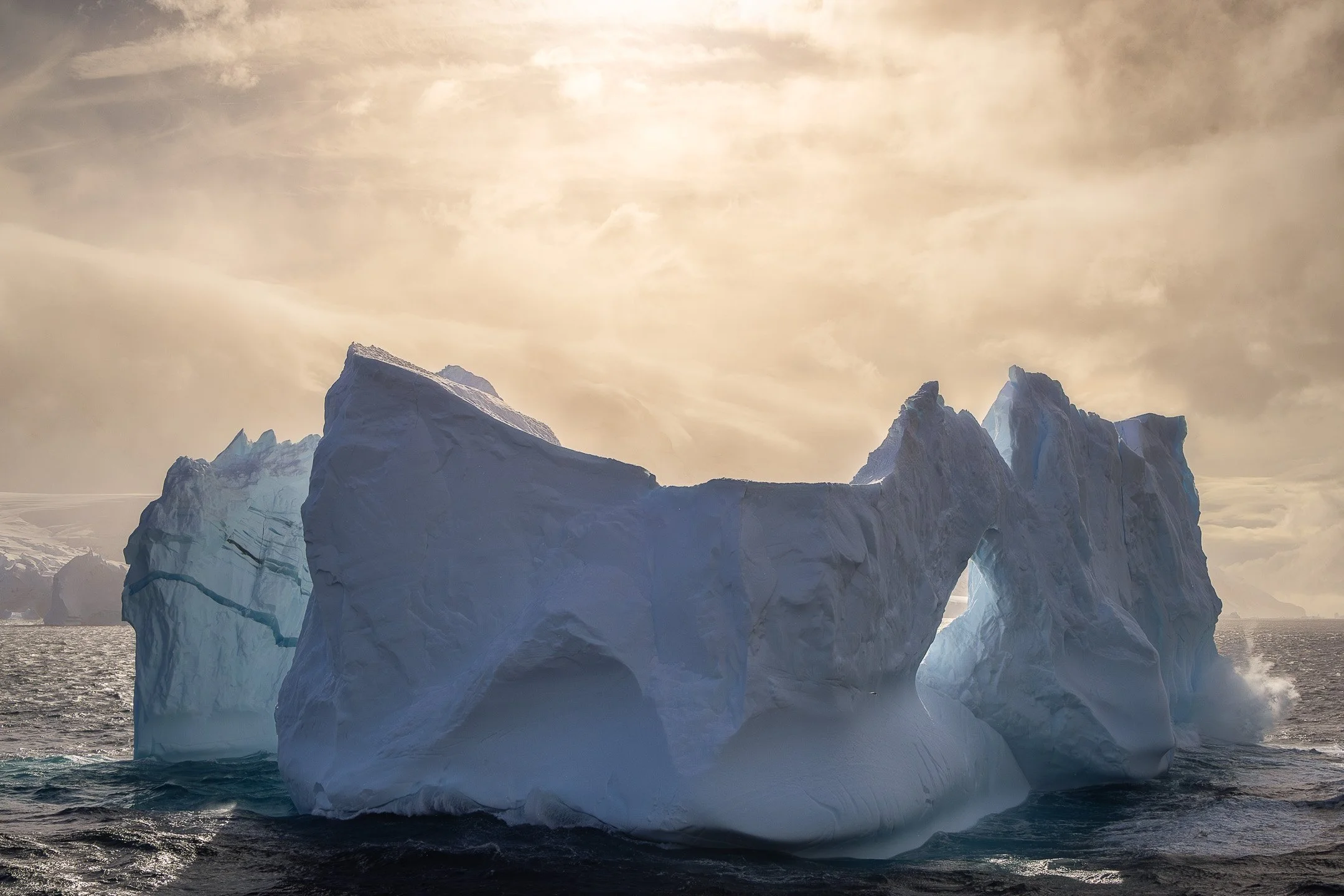
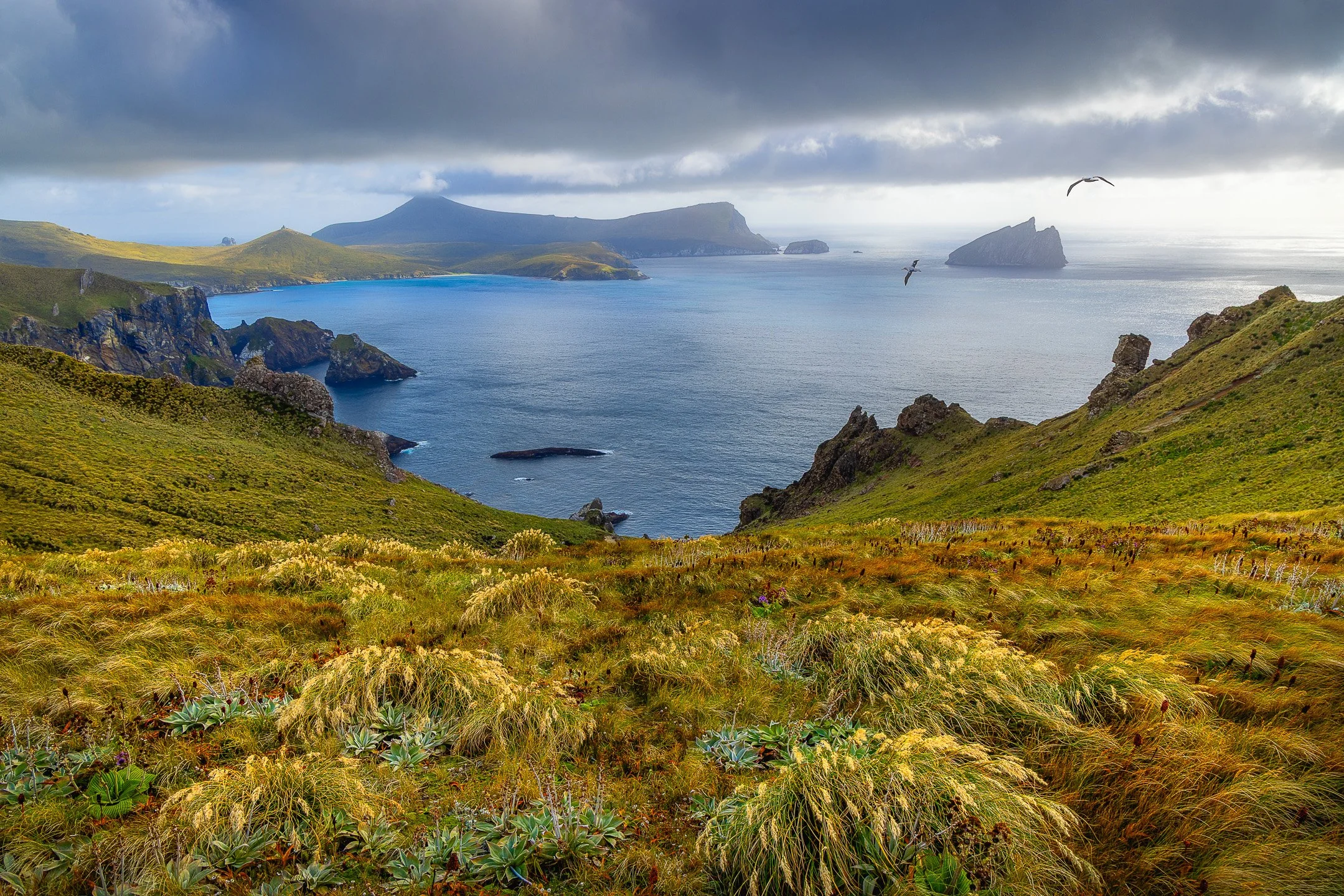
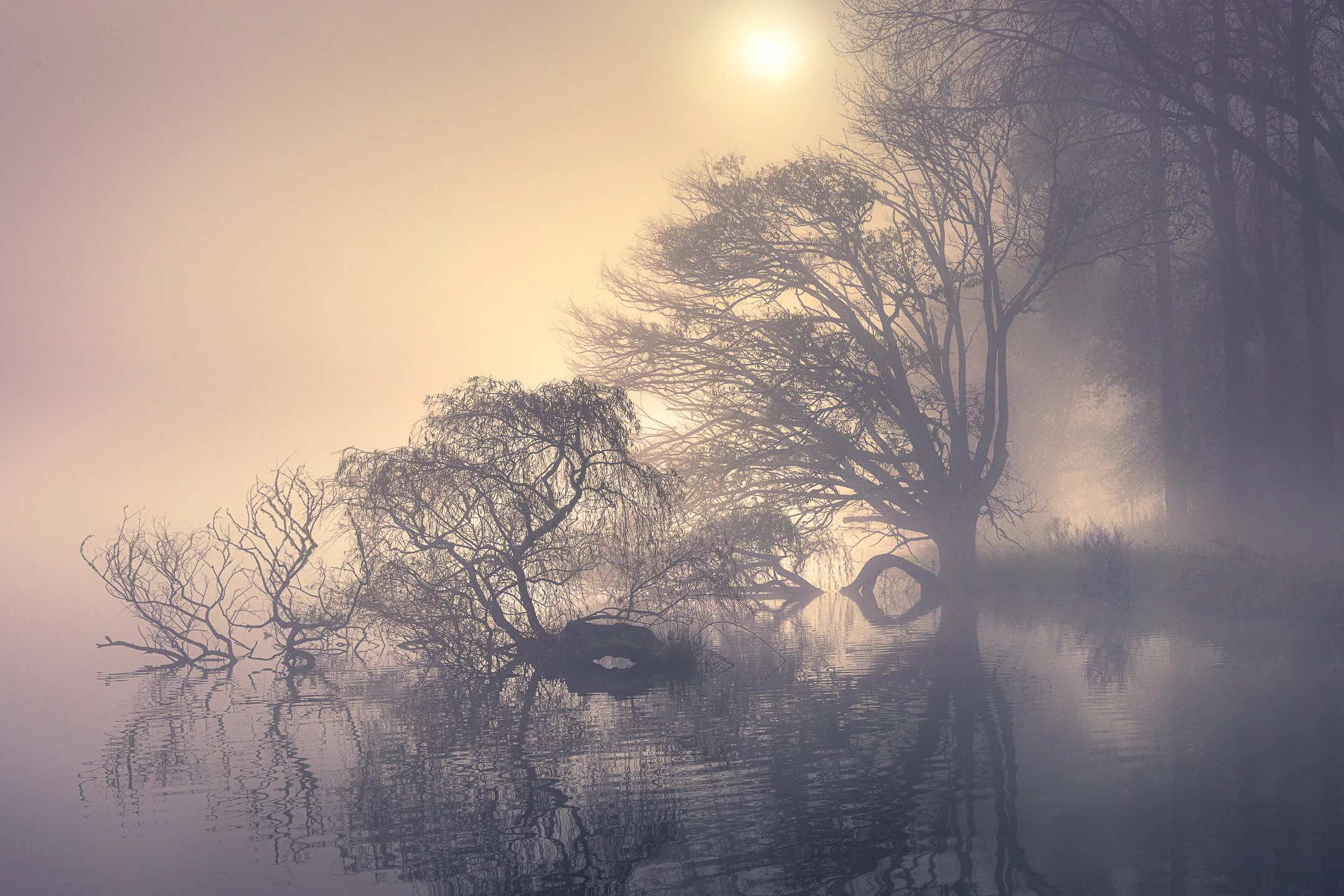
I arrived expecting cold — not just physical chill, but a particular visual cold: an Antarctica of the imagination, reduced to white and grey. The Ross Sea had other ideas. What I found instead was gold settling across volcanic peaks, pancake ice that looked impossibly like Monet's water lilies, and light that refused to behave the way Antarctic light was supposed to. For one hour in McMurdo Sound, the continent became the warmest place I have ever been.