
Wild Light: A Landscape Photographer's Journey Through the Balleny Islands
On the way south toward Antarctica, we passed the Balleny Islands on a grey afternoon in February 2026. I had been watching for them constantly, knowing how remote and seldom-visited they are, positioned at one of the most extraordinary geographic boundaries on Earth. The Antarctic Circle runs directly through the archipelago, with Young Island sitting just north of the line while Buckle and Sturge Islands lie to the south. To pass through this chain is to cross, literally and physically, into the true Antarctic.
That first crossing was almost invisible. The islands emerged briefly through thick cloud after lunch, their ice-covered cliffs barely distinguishable from the grey sky above them before they disappeared again. Humpback whales surfaced around the ship as we pressed on, their flukes rising and falling in the heavy swell. The islands themselves remained hidden, as though they simply were not ready to be seen yet.
I changed into my polar jacket out on deck, pulling it on over a t-shirt. It was twenty degrees inside the ship and minus one outside, a stark contrast that made it clear we were standing on the threshold of the real south. That threshold, it turned out, was exactly what the Balleny Islands are. They are not quite Subantarctic, yet not quite fully Antarctic either, existing as something caught in between and entirely their own.
The return passage, two weeks later, was a different story entirely.
After breakfast on the way north, I photographed the misty middle island from the deck. It was barely visible, with chinstrap penguins somewhere on the slopes, though they were far too distant to be certain the camera lens had actually found them. After lunch, as we approached the northernmost island, a notification arrived from the expedition team that icebergs had been spotted ahead and the light was extraordinary. I put down what I was doing and went straight outside.
What I found waiting on the top deck stopped me completely. The light was easily the best of the entire trip, a fierce, directional glare breaking through the cloud in concentrated shafts that caught the volcanic rock and glacial ice with an intensity I had not encountered anywhere else on the journey. The wind was blowing a full gale, making standing on the top deck to shoot physically difficult, incredibly cold, and unstable. I stayed up there anyway, holding my ground for as long as that light held.
The Balleny Islands had been nothing more than a quiet threshold on the way south, but on the return journey, they became something else entirely.
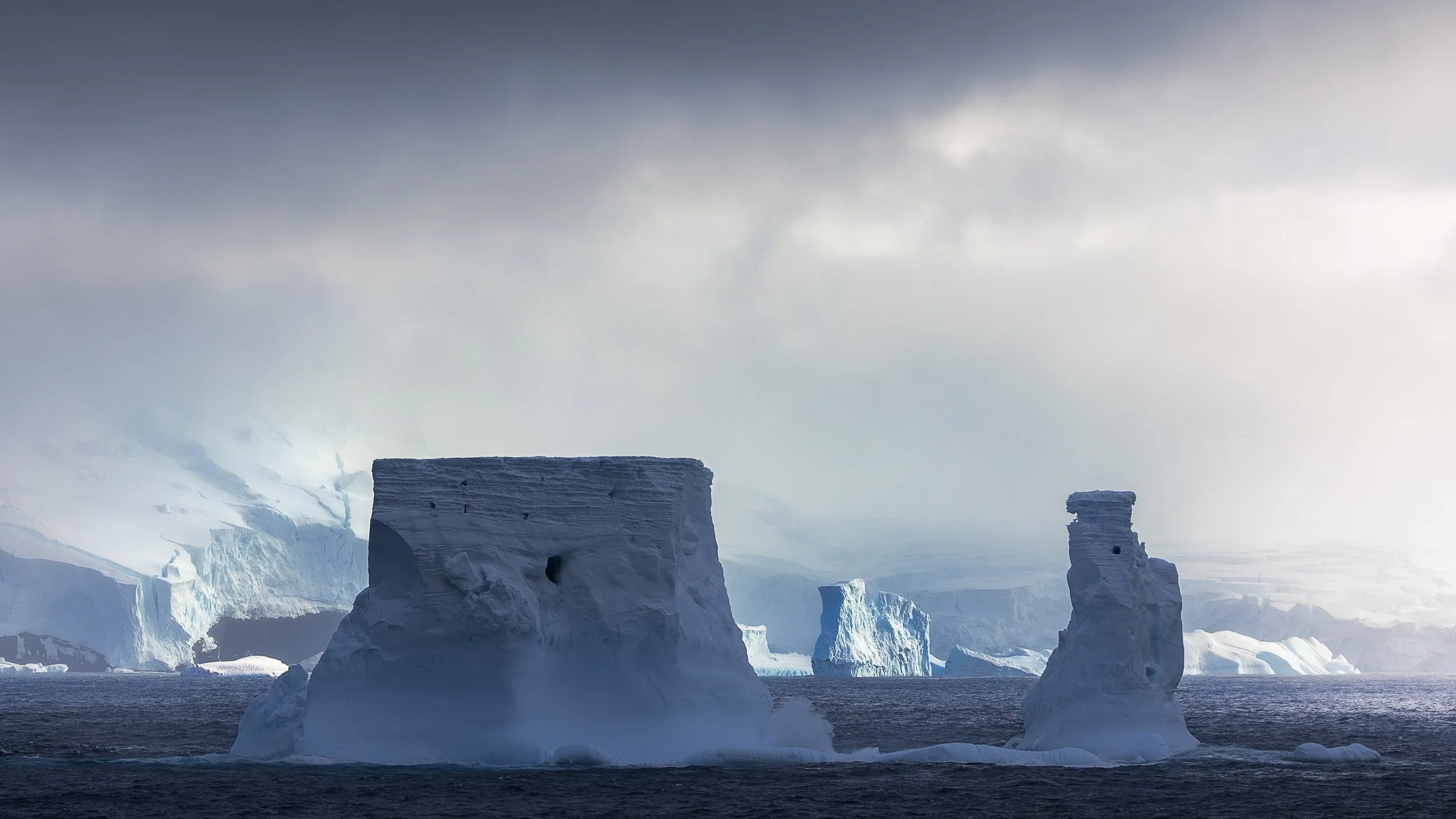
The Threshold
Two ice forms frame the entrance to the Balleny Islands world — icebergs, cliffs, mountains, and glaciers stretching away beyond them into the mist. Pass through, and there is no going back to what you imagined this place would be.
Monoliths Adrift
The waters surrounding the Balleny Islands are densely populated by ice. Vast, slow-moving forms drift on currents completely invisible from the surface, having calved from glaciers on the islands themselves or carried north from the main continent beyond. Some are merely the size of a house, while others stretch out to the size of an entire city block. Every single one of them carries the weight of something ancient and unhurried, entirely indifferent to the wild weather moving around them and the water that is slowly, imperceptibly, taking them apart.
Photographing these icebergs from the deck of a moving ship in such conditions is an exercise in patience and timing. The forms change constantly as you circle them, where a flat, unassuming face suddenly becomes a dramatic profile, or a shadow shifts to reveal a deep texture that was invisible just a moment before. Each iceberg is entirely unique, shaped by the specific history of its calving, its drift, and its ongoing encounter with the wind and water. No two are alike, and none of them stay the same for very long.
What struck me most was not their sheer size, though the scale is genuinely difficult to comprehend from the deck. It was their sculptural quality, giving the distinct impression that time and water had worked these forms with something approaching real intention. I watched a perfectly circular portal worn clean through several metres of solid ice, and two towers catching the very last of the directional light while waves broke violently at their base. These were not random accumulations of frozen water. They felt like genuine monuments, made by no one, heading nowhere in particular, and completely indifferent to ever being seen.
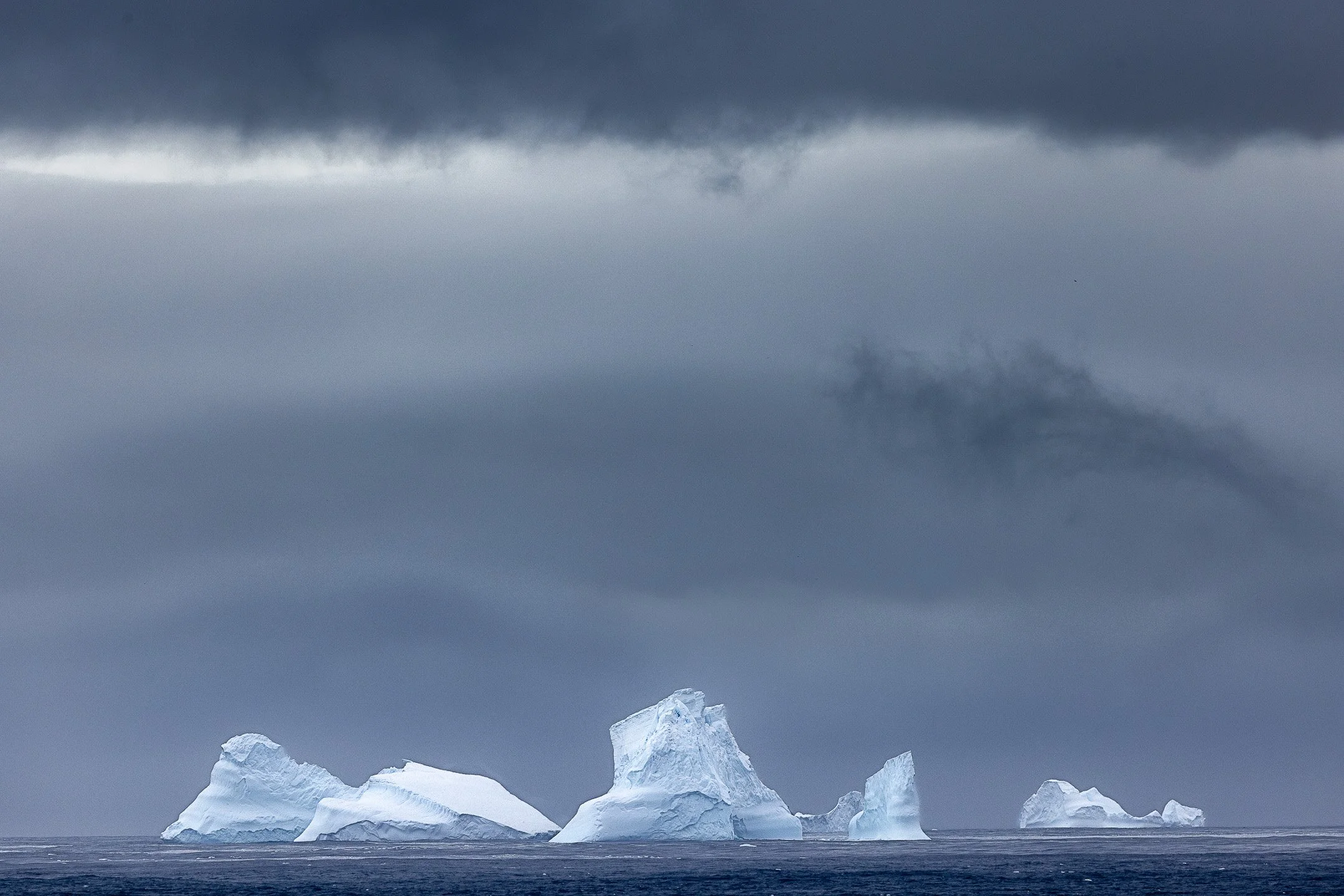
Adrift
A scattered group of ice forms sits low on the horizon beneath a heavy, layered sky. At this distance they seem almost fragile — small white shapes in an overwhelming expanse of dark water and darker cloud.
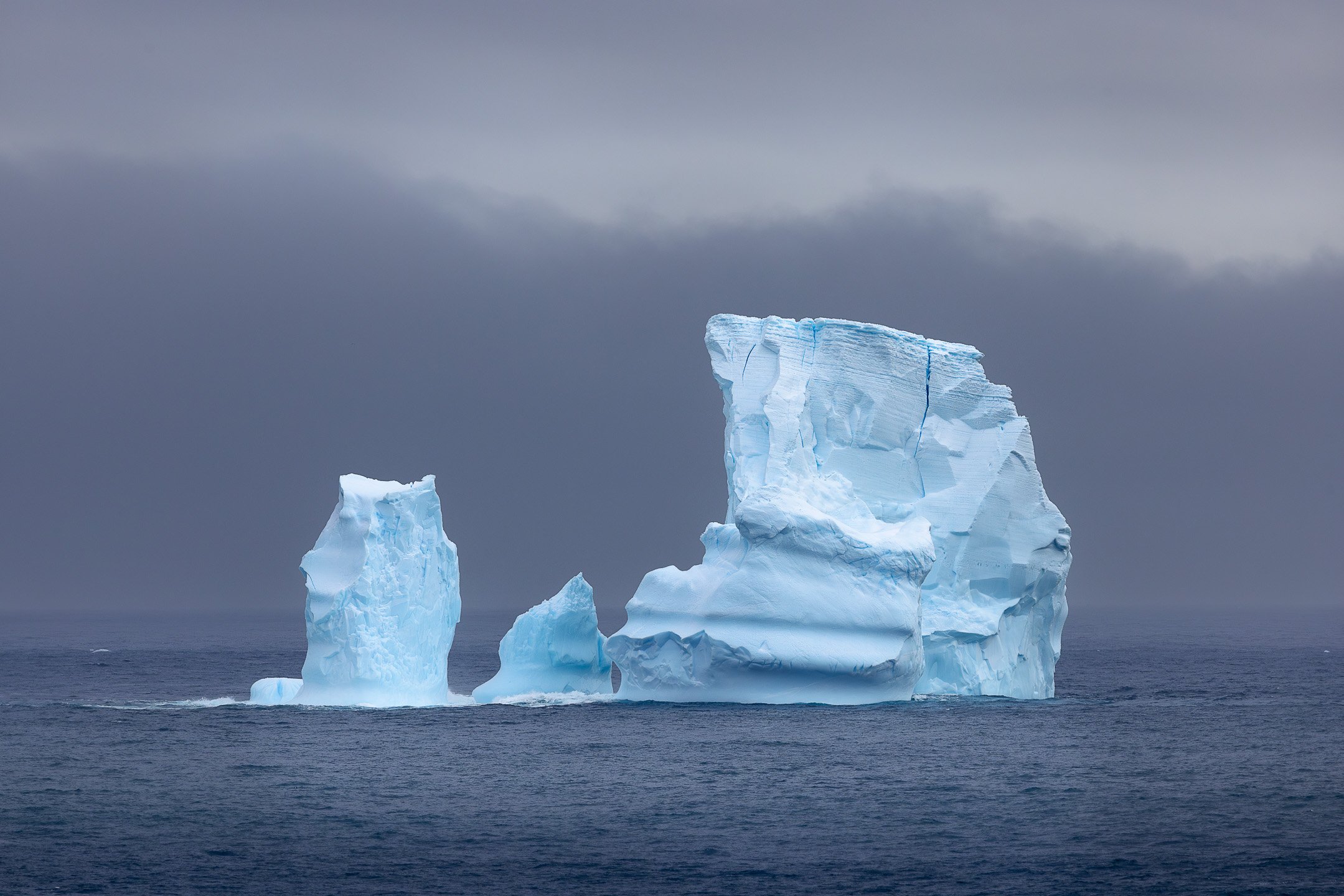
Sail
Two forms in close proximity: one massive and blocky, one smaller and more delicate, both luminous against the steel-grey sea. Together they read as companions — two travellers moving slowly in the same direction, on a journey that began long before either of us arrived.
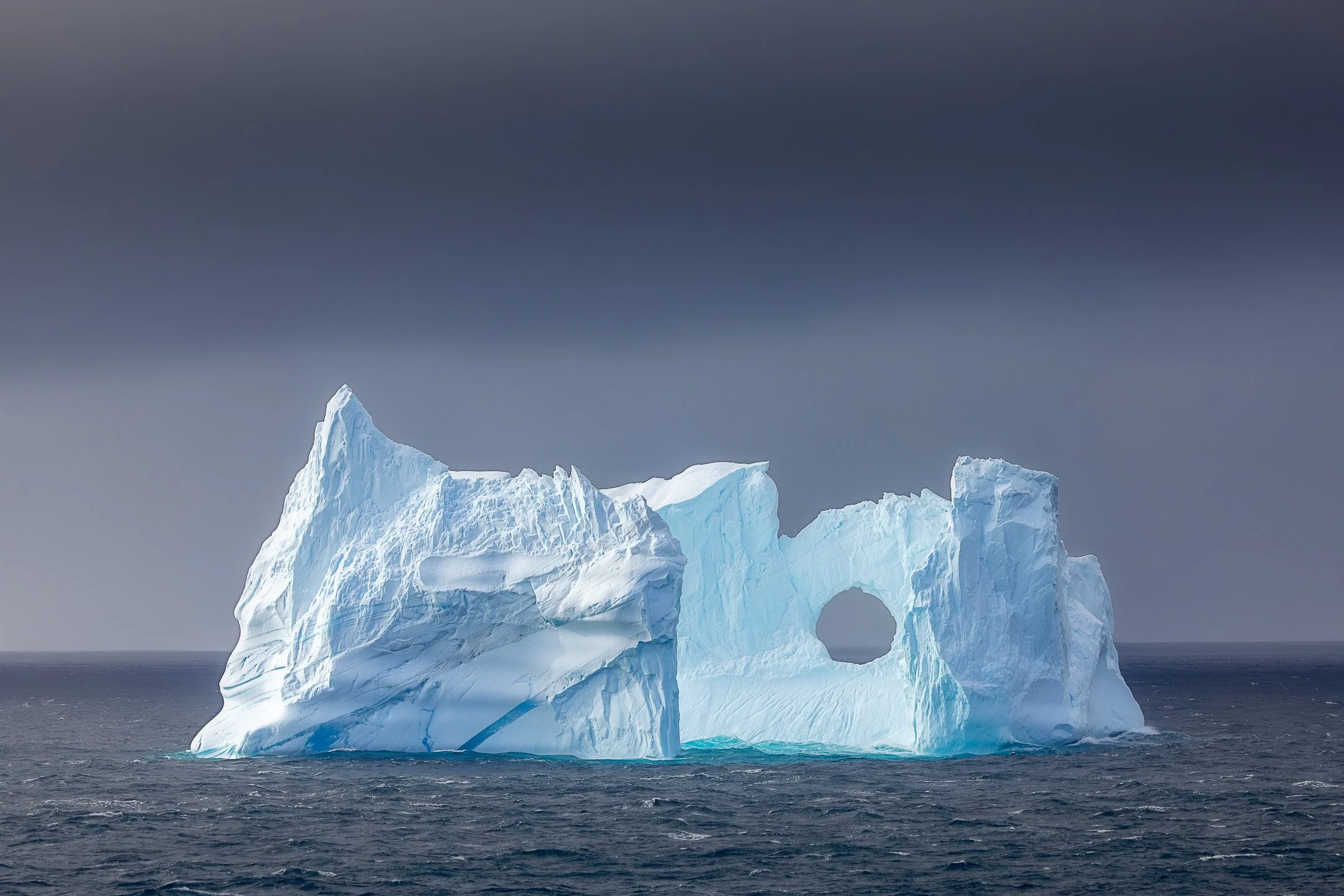
The Eye
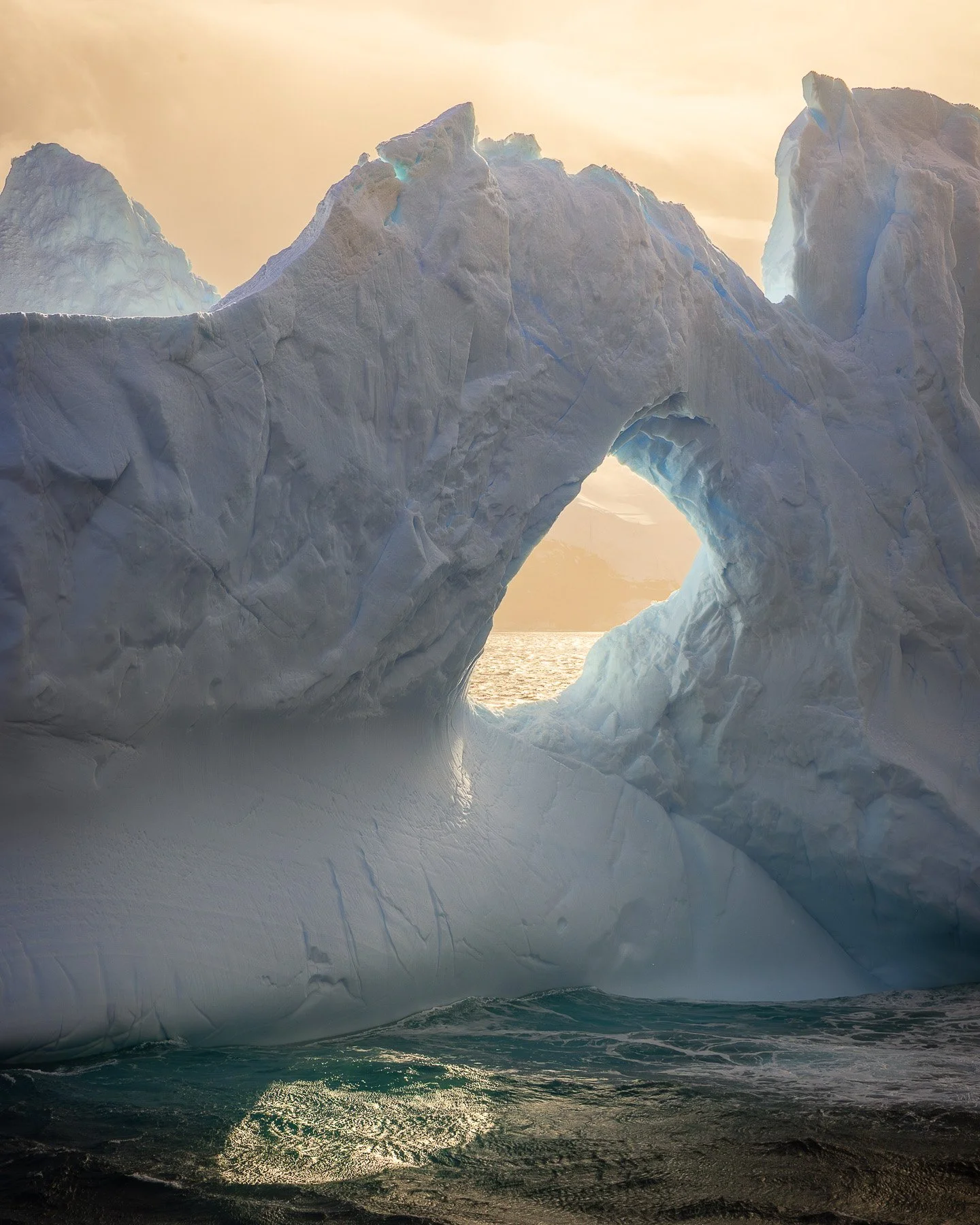
A perfect circular opening worn through the body of a large iceberg — so precise it seems impossible, so inevitable it seems designed. Time and water made this. Nothing else could have.
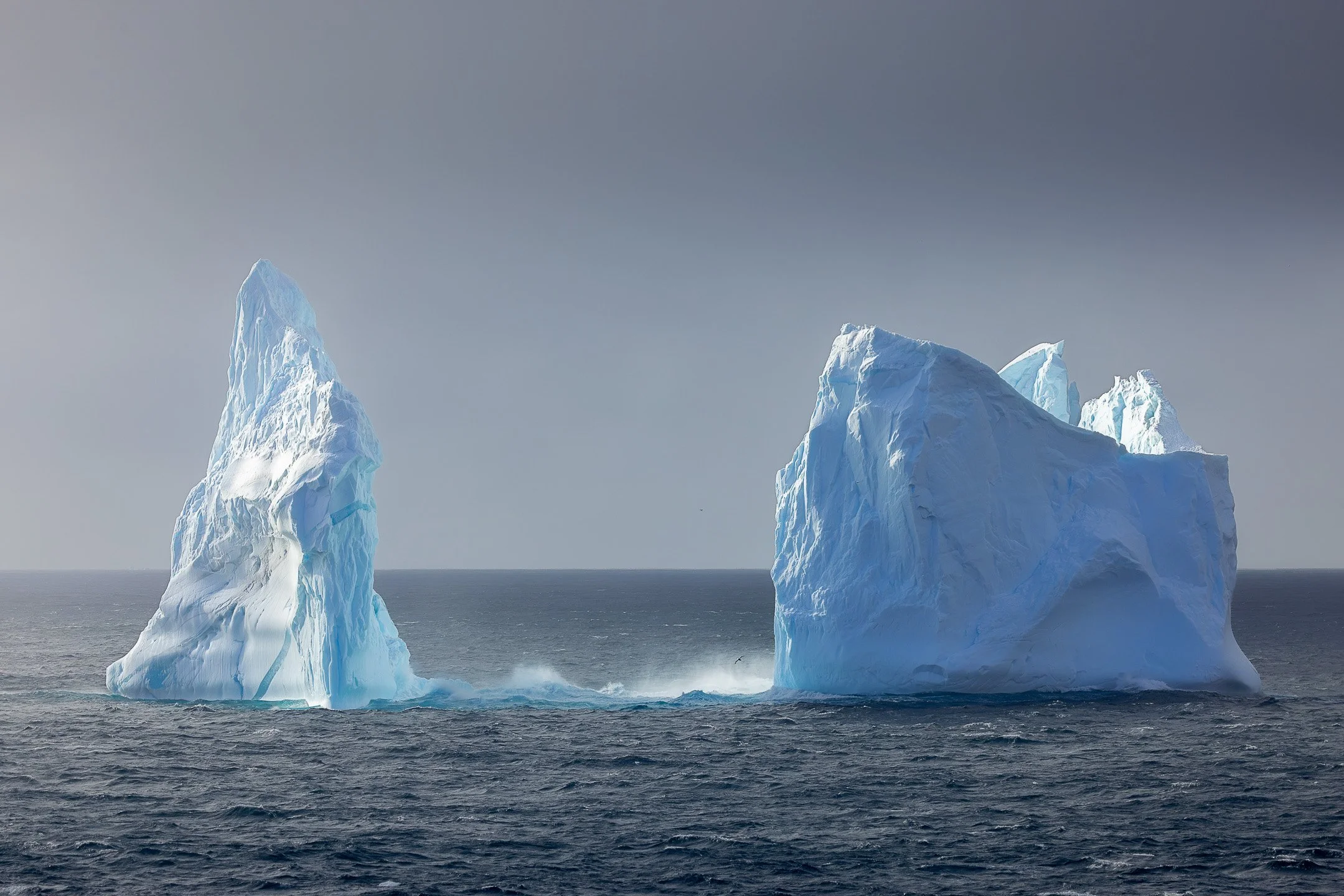
Not Alone
Two ice towers rise from a rough sea, catching directional light while waves break white at their base. Look carefully at the spray — somewhere in the salt and motion, a seabird holds its position against the wind.
Fierce Light
The Balleny Islands rise from the Southern Ocean like the exposed spine of something ancient and unfinished. Volcanic in origin, remote even by Antarctic standards, and battered by some of the most persistent weather on Earth, they are not a place that offers itself easily to a visitor. On the return passage north, after two weeks in the Ross Sea had already changed how I worked and what I looked for, I found myself photographing in conditions that demanded everything I had learned about reading light quickly and committing to a shot without hesitation.
The light here is not the soft, diffuse illumination of a typical overcast day, nor is it the golden warmth of a clear Antarctic evening. It is something far harsher and more volatile, breaking through the cloud in concentrated shafts and catching the edges of volcanic rock and glacial ice with an intensity that flattens everything it misses. The landscape moves in and out of visibility in mere minutes. A mountain face that was completely lost in grey mist will suddenly, briefly, and ferociously light up, revealing the ochre volcanic rock beneath the ice as though the weather had decided, just for a second, to show you what was really there.
Photographing in this environment required total concentration. The wind was blowing a full gale on the top deck, making it physically difficult just to stand still long enough to compose a frame. There was no such thing as waiting for the right moment to arrive; there was only the immediate present and whether I was ready for it.
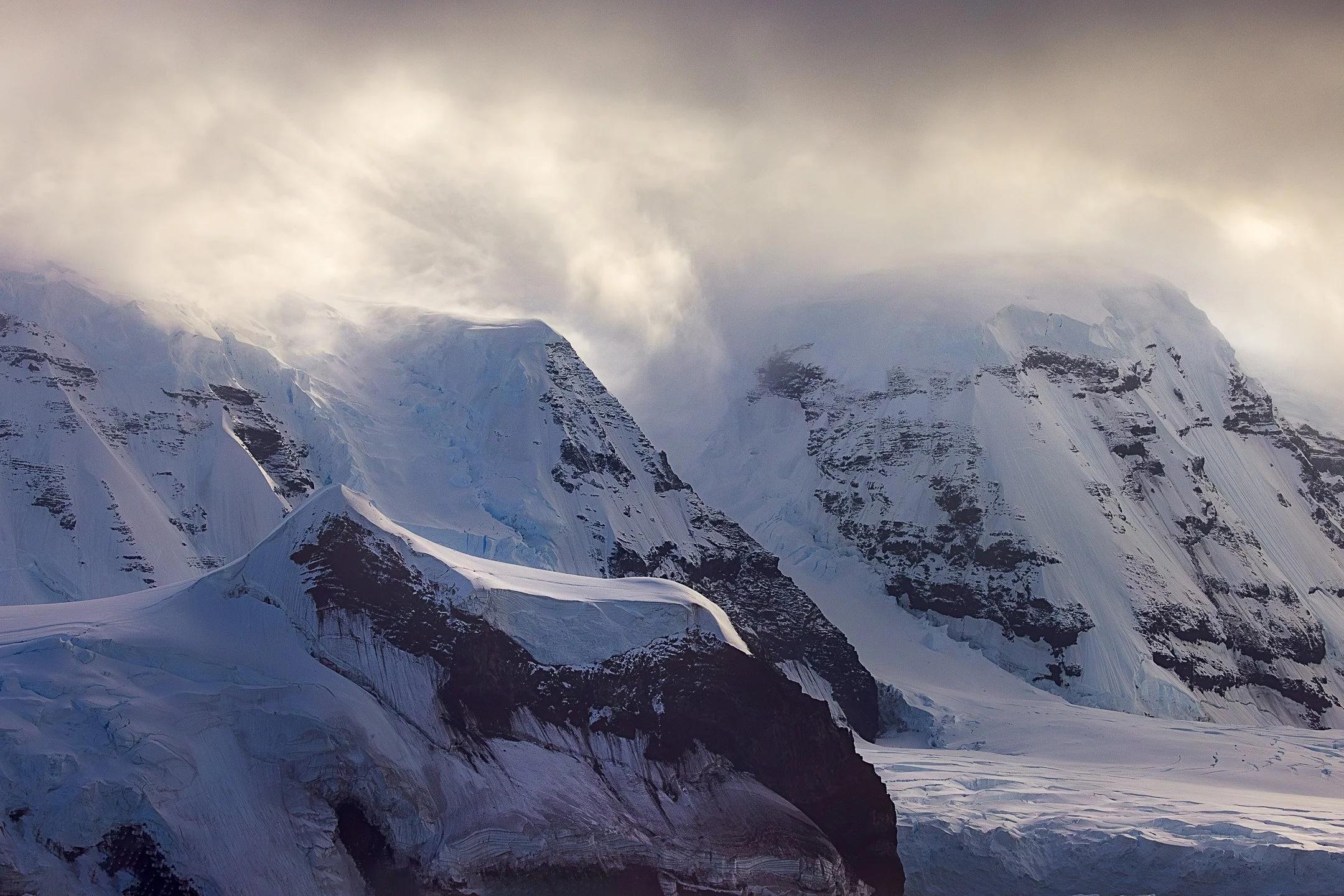
Below Light
Volcanic peaks sit beneath a pressing cloud ceiling, their dark rock faces and glacial flanks caught in the charged atmosphere between storm and sky. The light is above, withheld — and the landscape waits beneath it.
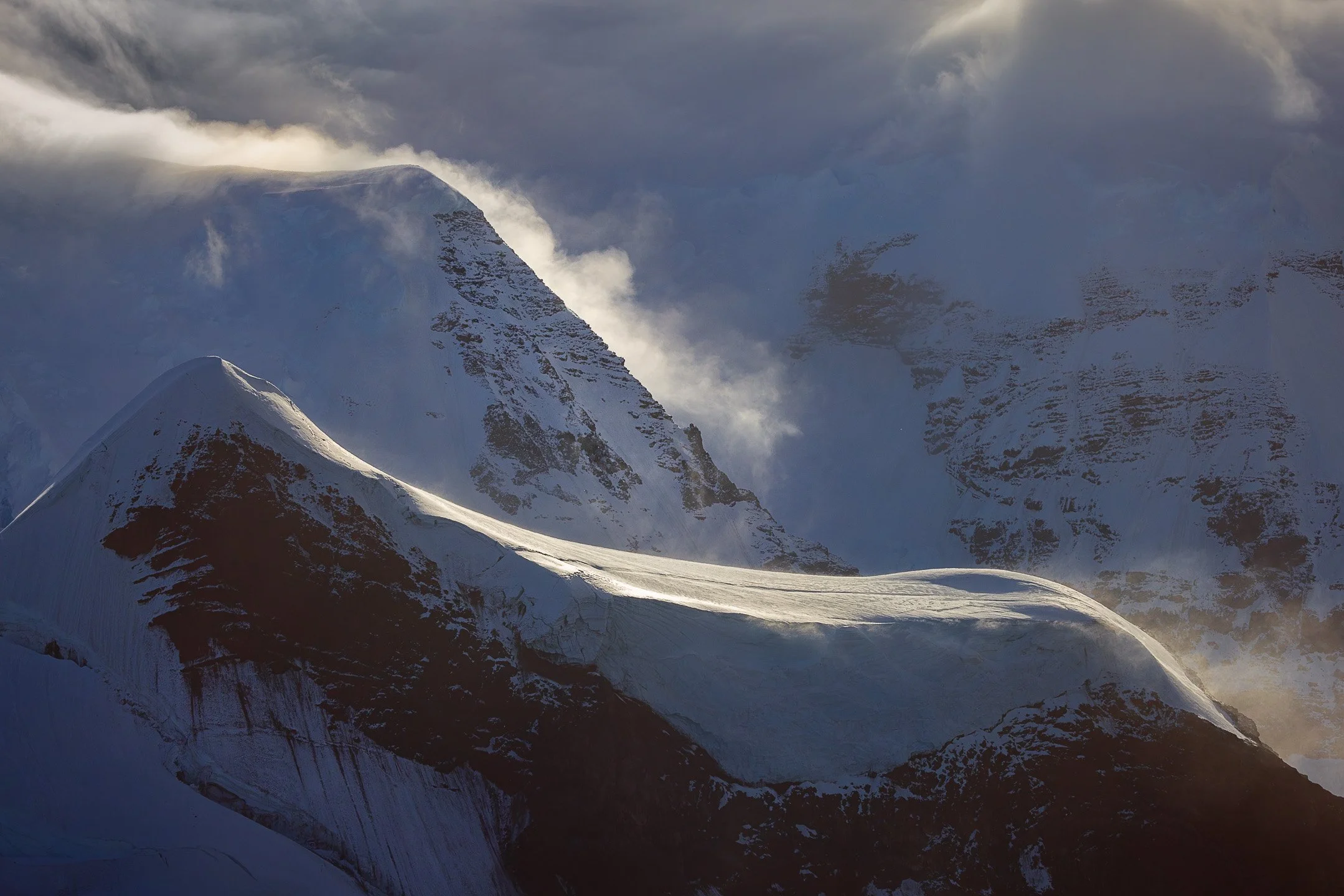
Illuminated Edges
Cloud burns bright along the peak's ridgeline, tracing its edge against the sky. Below, a single curve of ice catches the same fierce light — luminous, clean, and precise.
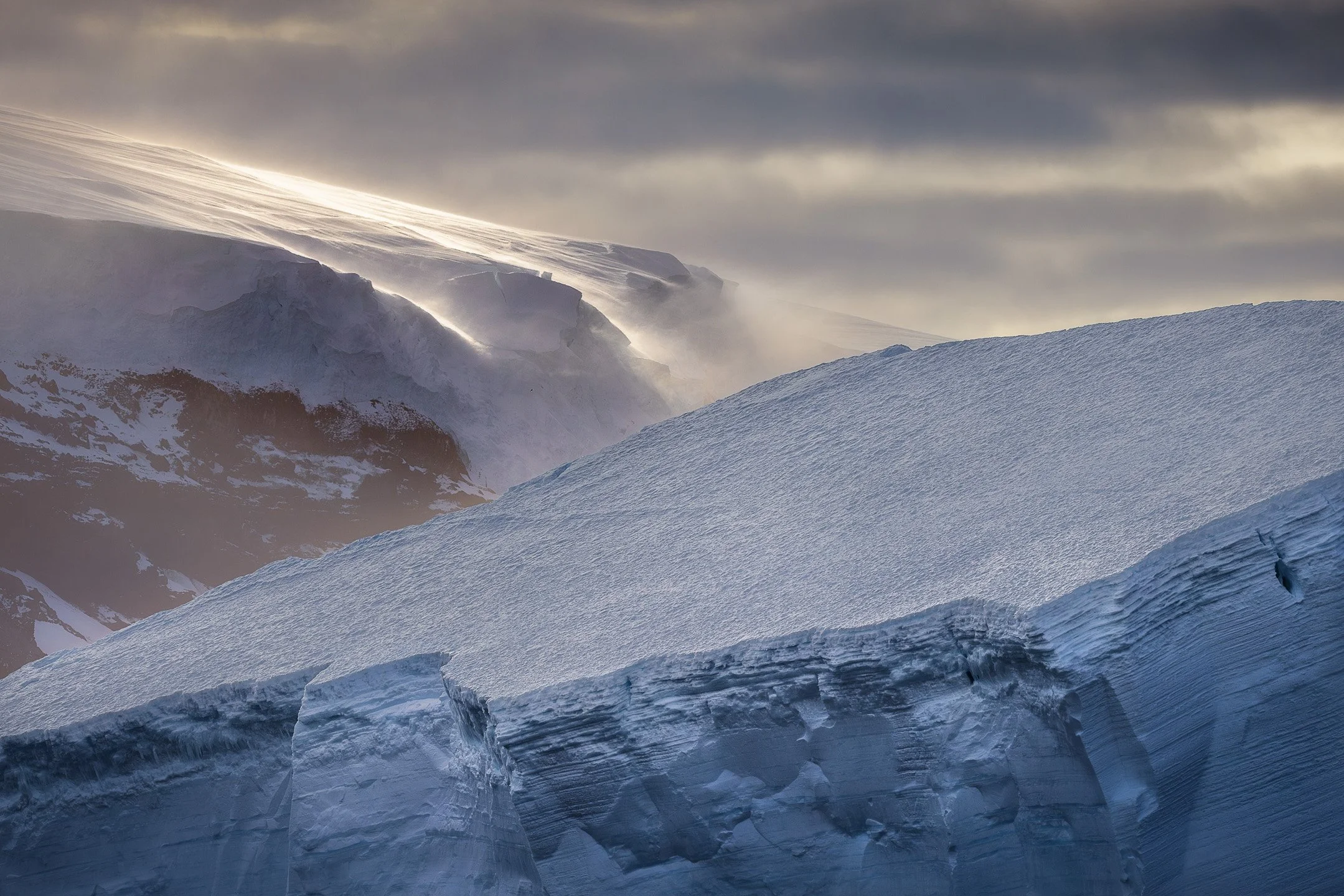
Where the Light Goes
The light pulls back toward the horizon, leaving the glacial slope in a warm, diffuse glow that is almost gentle compared to what came before. In the foreground, an iceberg catches the last of it — a pale anchor in a softening world.
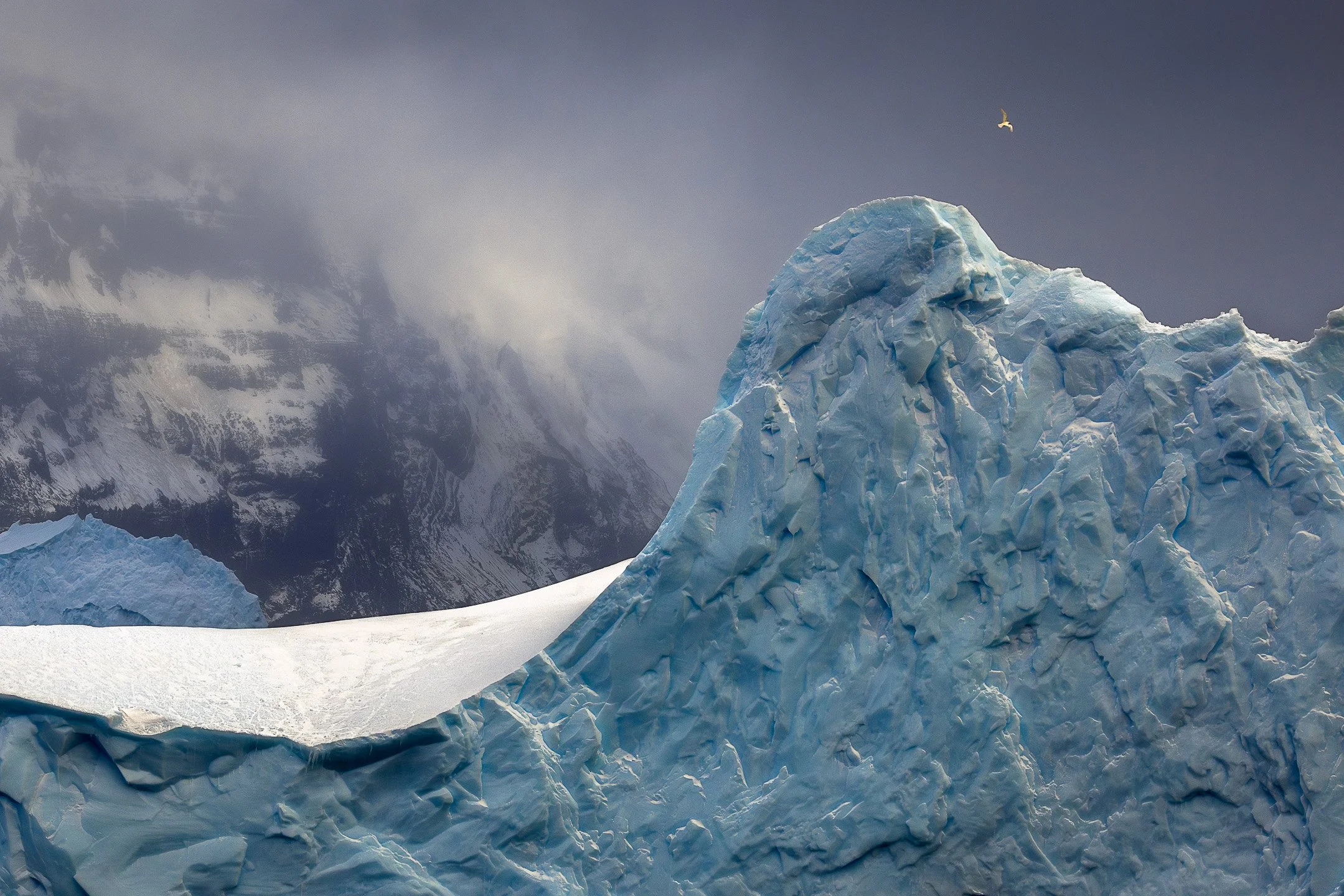
Blue Drift
Mist moves across the peak of an iceberg in the middle distance, the volcanic mountain behind it half-dissolved in cloud. Somewhere above, almost invisible against the grey, a single bird holds its position in the wind. The fierce light has passed. What remains is blue, and drifting.
The Turning
The Southern Ocean light is rarely generous. For most of our time around the Balleny Islands, the sky had been heavily overcast, creating a diffuse ceiling that flattened forms and drained the colour from everything beneath it. As those clouds finally began to break, a welcome contrast and texture returned to the sky, giving the surrounding icebergs a sudden sense of drama and presence, though direct sunlight still remained elusive.
Then, the cover broke completely.
What unfolded over the next hour was the exact kind of moment that justifies every uncomfortable, unpredictable, and logistically difficult expedition photograph you will ever take. A warm golden light poured straight across the Southern Ocean, catching the ice in ways I had not witnessed anywhere else on the journey. The two icebergs I had already photographed in the grey, breaking light—the exact same forms in the exact same water—were suddenly transformed. As our ship circled them, the larger structure began to reveal something I had completely missed from the opposite side, exposing a monumental arch worn clean through the body of the ice that perfectly framed the golden sky beyond it.
By this stage of the journey, I was no longer surprised. The Ross Sea had already shown me more than enough to make me release my baseline expectations entirely. What I felt instead was a profound sense of awe, that specific, quieting kind that arrives only when a place completely exceeds not just what you imagined, but what you thought was even possible.
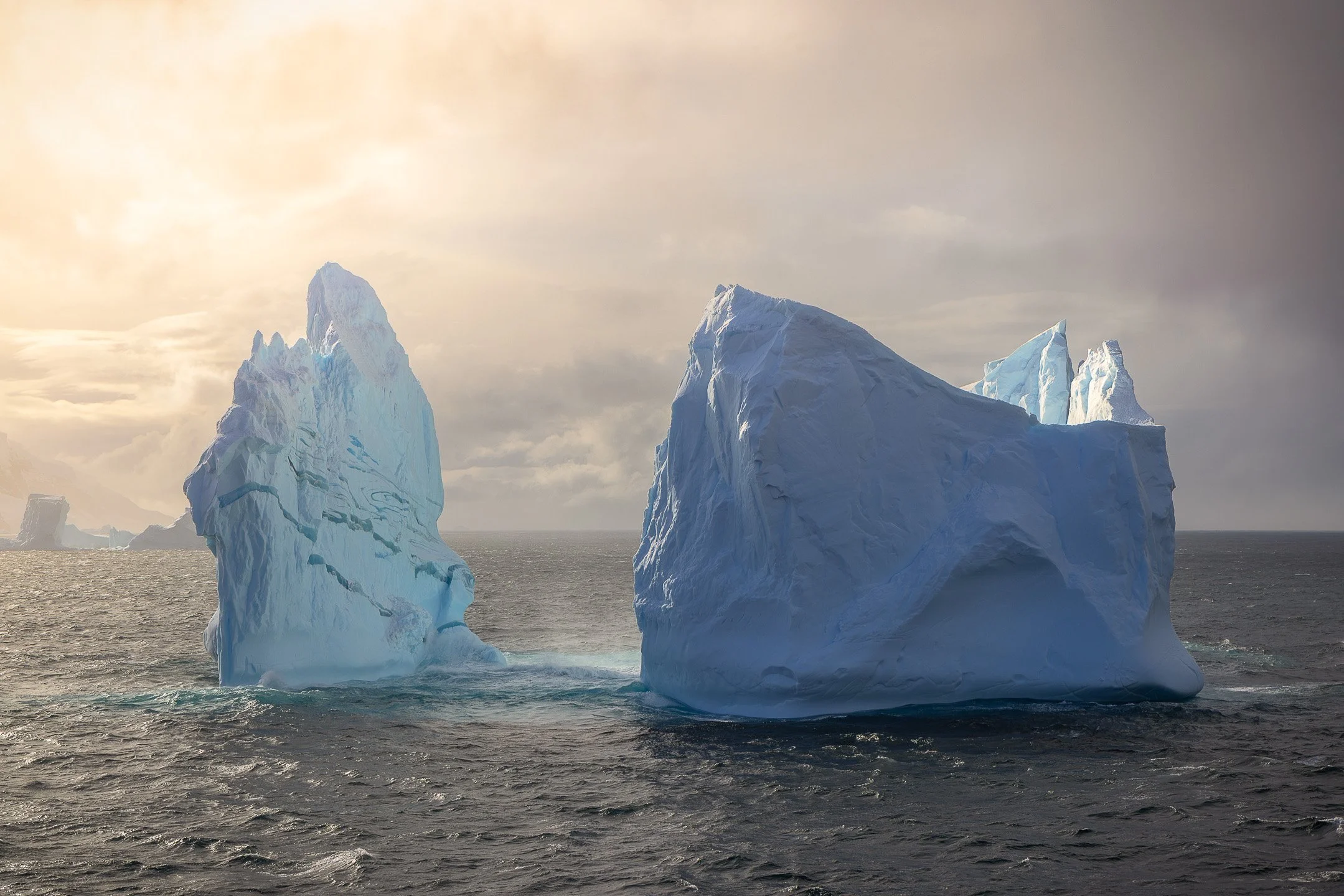
Turning Gold
The same two icebergs from Not Alone, now bathed in warm golden light. The Southern Ocean and the sky above it are barely recognisable as the same place photographed an hour before. Nothing has changed except the light — and everything has changed.
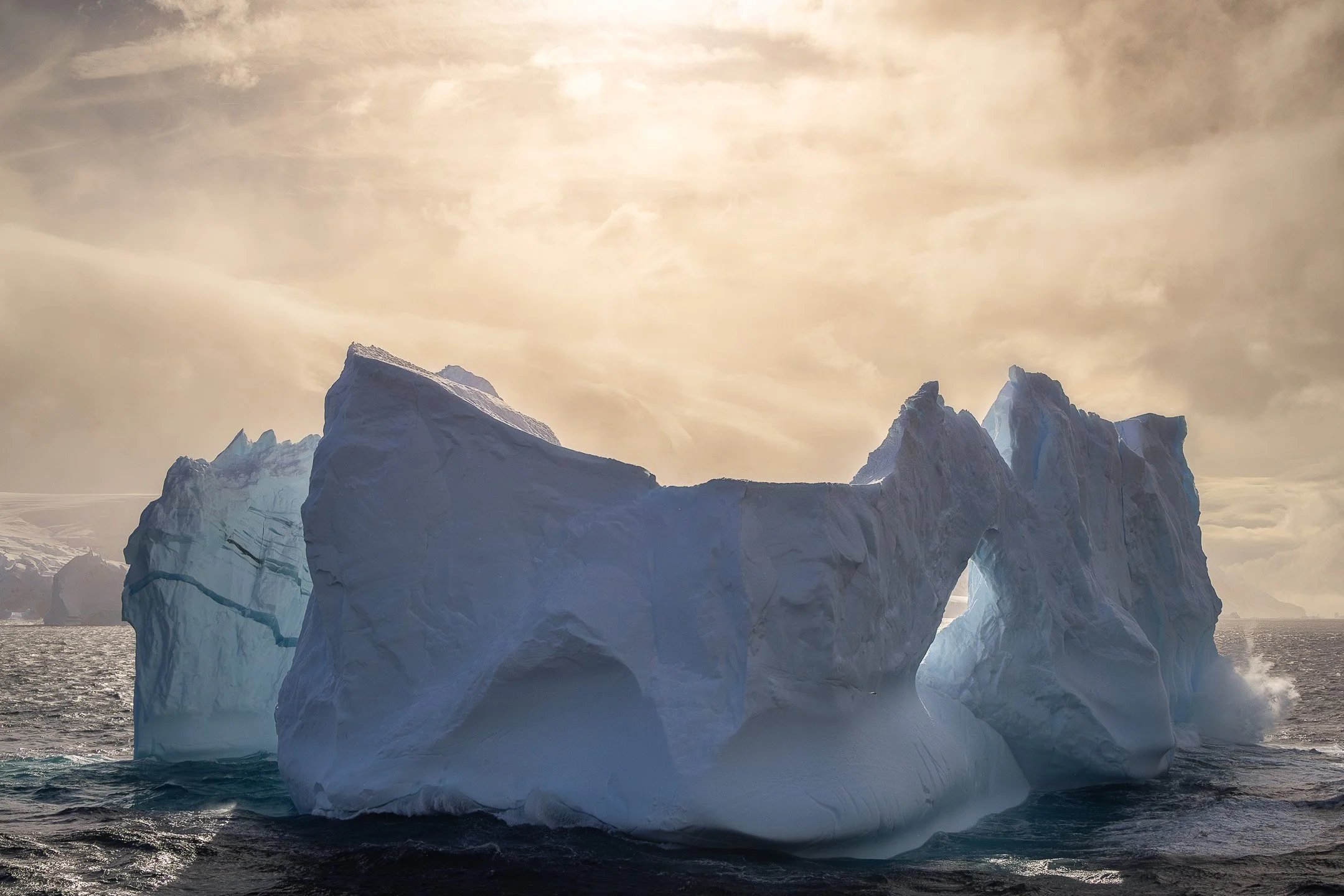
The Gateway
Seen whole for the first time: a monumental arch worn through the body of a large iceberg, the golden sky visible through its opening. The scale is difficult to absorb — stand at its base, and the arch would dwarf you completely.
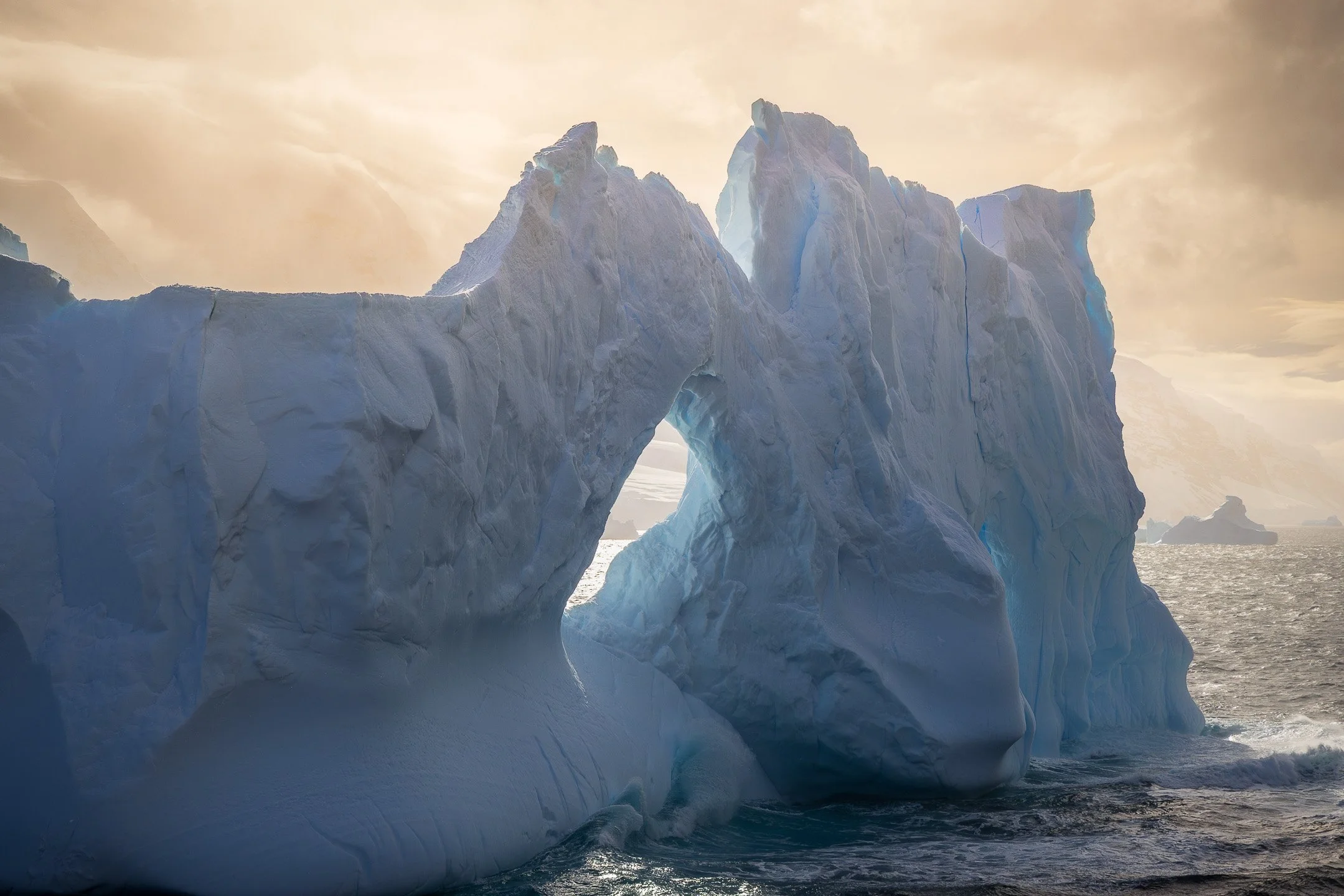
Golden Passage
Moving closer, the arch dominates. The ice on either side catches the warm light differently — one face bright, one in shadow — the opening between them a portal to something just out of reach.
The Way Through
In front of the arch, looking through: golden sky framed by sculpted ice, the ocean visible at the edge. A moment of stillness inside a form that is slowly, imperceptibly, dissolving.
Photographing the Balleny Islands: Conditions, Light, and Staying Ready
Shoot in the Conditions You're Given
The Balleny Islands do not offer comfortable shooting conditions. On the return passage, the wind was blowing a gale on the top deck — cold, persistent, and strong enough to make standing still a physical effort. Holding a long lens steady in those conditions requires planting your feet, bracing against whatever structure is available, and accepting that some frames will be lost to camera movement. The temptation to go back inside is real. Resist it. The images that matter in places like this are made in exactly the conditions that make photography most difficult.
Stay Connected to What's Happening Around You
The best light of the entire journey arrived while I was inside the ship processing photographs. A notification from the expedition team brought me back on deck in time — but only just. On an expedition vessel, the people around you are an extension of your own awareness. Stay connected to the team, keep your camera accessible, and never assume that because conditions look poor from inside, they will remain poor outside. In the Balleny Islands, the light can change completely in minutes.
Two Cameras Are Worth It
I brought two cameras on the trip, primarily as a backup. What I discovered was that having both with me while shooting was one of the most practical decisions I made. Swapping lenses in cold, windy conditions costs time and concentration — neither of which you can afford when the light is breaking through cloud and the ship is moving. Throughout the journey, approximately ninety percent of my images were taken with a 100-500mm lens. But having a 24-105mm lens on my second camera was invaluable — particularly during The Turning, where the arch iceberg required both intimate detail and wider context, and where the speed of the ship meant that what filled the frame changed from moment to moment. Icebergs move fast when you are on a ship. Having two focal lengths immediately available meant I could respond to that movement rather than chase it.
Conclusion: The Threshold Crossed
The Balleny Islands are not a destination in the conventional sense. They exist as a crossing, a place caught both geographically and experientially between two entirely different worlds. To pass through them is to leave the Subantarctic behind and enter something genuinely distinct, a region that is colder, more remote, and operating on a massive scale that the islands of the Southern Ocean only ever hint at.
I passed through them twice, and they felt like completely different places each time.
On the way south, they were barely there at all, offering just a few ice-covered cliffs glimpsed briefly through thick cloud. It was a threshold crossed almost without knowing it, where the Antarctic Circle running through the archipelago felt like a technicality rather than a real experience. The true Antarctic still lay ahead, entirely unimagined.
On the return passage two weeks later, they gave me absolutely everything. They offered the best light of the entire trip, icebergs of extraordinary sculptural complexity, and raw volcanic rock revealed through wind-driven snow by concentrated shafts of fierce, golden light. Then there was the arch, that monumental opening worn straight through the body of a large iceberg which framed the golden sky beyond. It remains one of the most astonishing things I have encountered in a lifetime spent behind a camera.
What the Balleny Islands ultimately taught me was the deep relationship between patience and presence. A quote from Richard Byrd that circulated among the expedition team on that extraordinary afternoon put it precisely, advising to wait, and give the wind and tide a chance to change. The light that produced these images was not something we could predict or plan for. It arrived simply because I was out on deck and ready, and because the wind and tide, on that particular afternoon, finally decided to shift.
By the next morning, the volume of icebergs was increasing rapidly. Land appeared on the starboard horizon as a mountain range emerged from the haze some fifty kilometres away. Although we could not land at Cape Adare, we passed close enough to see the peaks clearly, along with the icebergs floating past them and the penguins resting on the ice. The Ross Sea was finally beginning.
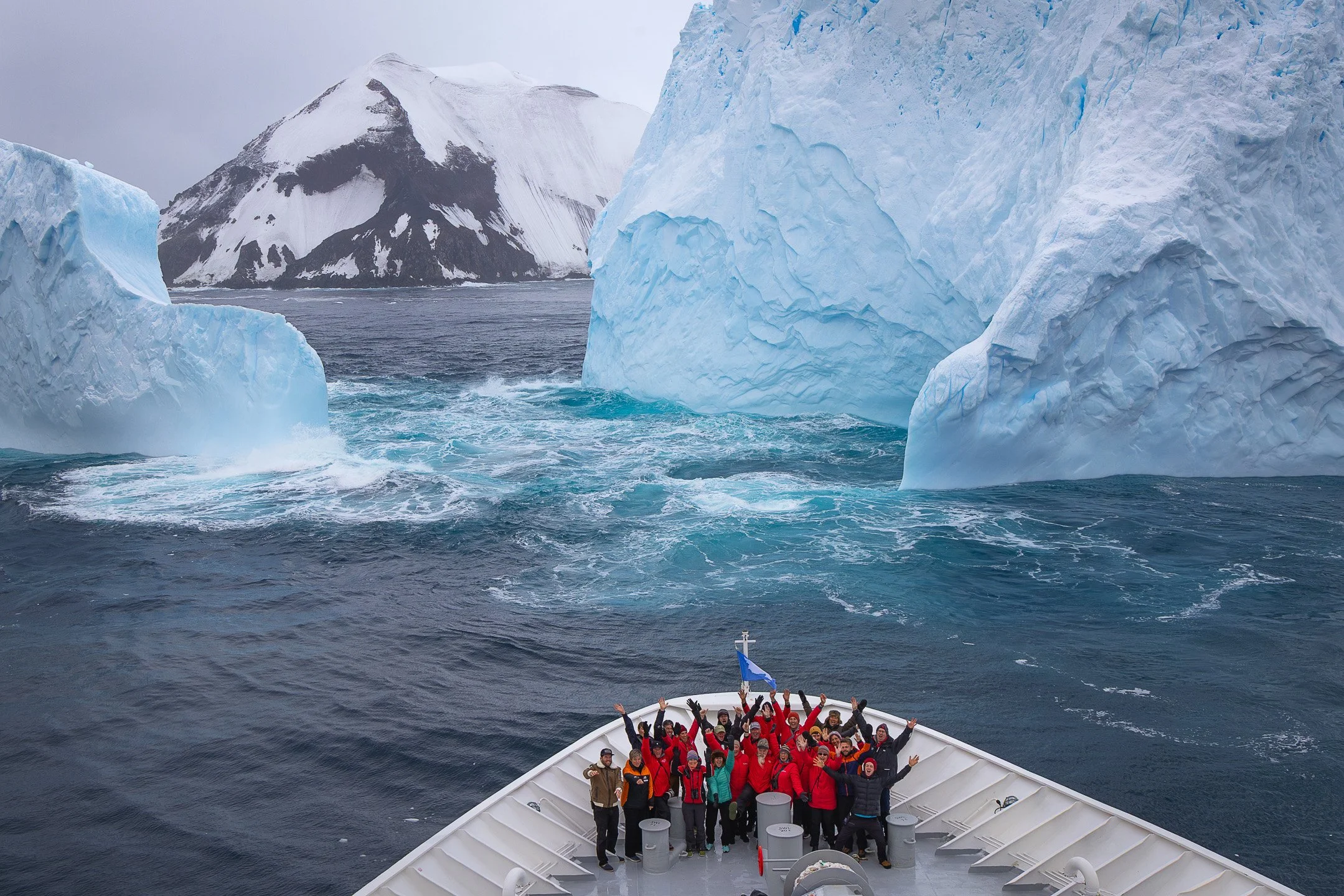
The Expedition Team at the Balleny Islands
Some moments don't need a long lens. This one just needed everyone on the bow at the same time.
More from the Antarctica series
This article is the second in a series documenting a journey from the Subantarctic Islands to the Ross Sea.
← Previous: Living Topography: A Landscape Photographer’s Journey Through the Subantarctic
Next →: Warm Ice: A Landscape Photographer's Journey Through the Ross Sea
This story is part of an ongoing collection from the same journey south. Living Topography, the first chapter in the series, follows the passage through the Subantarctic Islands, where the distinction between landscape and life dissolves entirely. Warm Ice, the third chapter, captures the rare, golden transformation of the Ross Sea landscape.
Living Ice — An Upcoming E-book
Wild Light is the second chapter in a journey that began in the Subantarctic Islands and continues south into the Ross Sea region of Antarctica. I am currently developing a comprehensive e-book — Living Ice: A Landscape Photographer's Journey from the Subantarctic to Antarctica — that brings all three chapters together as a singular study of the far south.
Alongside a curated collection of images from all three expeditions, the book includes a dedicated photographer's chapter covering the mindset, Narrative Set framework, and technical adaptations developed across the entire journey — from the dense, living landscapes of the Subantarctic to the fierce, volatile light of the Balleny Islands and the unexpected warmth of the Ross Sea.
It is intended for photographers and travellers who want to look further into both the craft and the quieter, less tangible dimensions of working in wild and remote places.
To be the first to hear about its release, subscribe to my newsletter below.
Share this article
If you would like more of these visual stories, then scroll to the bottom and subscribe to my newsletter.
Other stories you may find interesting
Two visits, two weeks apart, to the flysch rocks of the Kaikōura coast. The same formation gave me a jagged sunrise the first time and a very different answer the second.